
Euro (EUR) to Swiss Franc (CHF) converter
Track the exchange rate
of the euro / swiss franc exchange rate
- Open
- …
- High
- …
- Low
- …
Rates shown for information only. Sources: European Central Bank daily reference rates (via Frankfurter) and CurrencyLayer.
- Over one year
- − 0.4 %
- Over 3 months
- + 1.0 %
- Over 30 days
- − 1.5 %
Where the rate sits over one year
0.92790
One-year low 0.90080 One-year high 0.94780
Figures computed on 04.10.2026 from European Central Bank reference rates.
The technical picture
of the EUR / CHF rate
Over twelve months, the EUR / CHF rate ends up almost where it started. It currently sits around the middle of that range.
The EUR / CHF rate has been easing over the past thirty days. The move is there but modest, and does not yet settle the quarter.

Euro falls against Swiss franc
EUR/CHF experienced a volatile week, marked by a sharp reversal. After peaking at 0,9487 without managing to cross the 0,9500 threshold, the pair dropped heavily on Thursday to 0,9260, below its late-August close of 0,9373. The cross eventually ended the week at 0,9320, recording a weekly decline of 1,18 %. The 0,9260 level becomes the support to watch, while the 0,9487 high constitutes the resistance.
Early in the week, the Swiss franc was among the lagging currencies due to the yield gap, with the SARON stagnating at -0,04 % and the 10-year Swiss Confederation bond yielding around 0,54 %. However, the trend reversed under the combined effect of concerns surrounding the 2027 French draft budget and the US threat of a diesel export ban, prompting investors to seek the safety of the franc amid European tensions.
Fiscal pressures and inflation in the eurozone
The single currency also suffered from an acceleration of eurozone inflation to 3,8 % in September, compared to 3,6 % expected, driven by an 18,8 % surge in energy while the core index remained contained at 2,2 %. The European Central Bank is keeping the door open for its October meeting after raising rates in September, with a Governing Council member not ruling out another hike.
Written from the weekly analysis by Jean-Marc Sabet, published on 04.10.2026. Read it in full: L’euro rattrapé par le budget français.
Your money deserves better
than your bank’s rate
Most banks add hidden margins on top of the real exchange rate. It seems free, but it is not.
At b-sharpe, we show you a clear, no-surprise rate with minimal fees. You see what you pay, and what you gain.
AMOUNT TO EXCHANGE





The data provided are for information purposes only and do not include subscription offers. Discover how we compare prices.
Today’s exchange rate
EUR to CHF
EUR to CHF conversion table

Conversion EUR – CHF

Conversion CHF – EUR
Our popular EUR converter pairs
EUR
 USD
EUR
USD
EUR
 GBP
EUR
GBP
EUR
 AED
EUR
AED
EUR
 AUD
EUR
AUD
EUR
 CAD
EUR
CAD
EUR
 HKD
EUR
HKD
EUR
 ILS
EUR
ILS
EUR
 JPY
EUR
JPY
EUR
 MXN
EUR
MXN
EUR
 NOK
EUR
NOK
EUR
 NZD
EUR
NZD
EUR
 SEK
EUR
SEK
EUR
 SGD
EUR
SGD
EUR
 ZAR
EUR
ZAR
EUR
 PLN
EUR
PLN
EUR
 THB
EUR
THB
EUR
 MAD
EUR
MAD
EUR
 DKK
EUR
DKK
EUR
 CZK
EUR
CZK
EUR
 RON
EUR
RON
EUR
 SAR
SAR
Our popular CHF converter pairs
The CHF / EUR rate, from
the floor to everyday life

Three years and four months of a currency floor
On 6 September 2011 the Swiss National Bank announced that it would no longer tolerate a euro below 1.20 francs and that it would buy foreign currency “in unlimited quantities” to hold it. The measure was unprecedented for the central bank of a rich country: it amounted to subcontracting monetary policy to the euro area in order to protect exporting industry.
On 15 January 2015, at 10.30 in the morning, it gave up without warning anyone. The franc gained close to 20 per cent in a few minutes, and some brokers went under that same day. Ten years later, that precedent still weighs on the pair: the market knows the SNB can act. It also knows the SNB can stop acting just as abruptly.
An exchange corridor with no equivalent in Europe
Behind the rate there are very concrete flows. Close to four hundred thousand people cross a border every day to work in Switzerland and are paid in francs while they spend in euros. The European Union is by far Switzerland’s first trading partner. For many people CHF/EUR is a salary rate before it is a market rate.
That is what makes the margin gap so sensitive here. On a monthly payment, one percentage point of difference between two intermediaries represents, over a year, the equivalent of several days of work. The comparison is not a theoretical exercise. It is measured on a payslip.

Convert your EUR to CHF
with b-sharpe
- Account creation
- Sending funds
- Delivery within 24 hours
excluding weekends and public holidays
- NO account opening fees
- NO account management fees
- NO account closure fees
Frequently asked questions about EUR / CHF exchange
The EUR / CHF converter
6 questionsWhat is the b-sharpe EUR / CHF currency converter for?
The b-sharpe EUR / CHF currency converter displays the interbank market rate in real time, updated every 5 minutes. This is the gross rate without any added fees, used as a reference to evaluate the real value of your exchange. You can also view the 30-day graphical evolution to visualise rate volatility. To convert your EUR to CHF at the best rate, visit change your currency.
How much is 1 euro in Swiss francs today?
The converter above shows you, live, the value of the euro in Swiss francs today, based on interbank market data. To find out the equivalent of a specific amount, enter it in euros and the conversion into Swiss francs is displayed immediately. This figure corresponds to the mid-market rate, without fees: it is the benchmark for judging whether the rate offered by your bank or another provider is favourable. The 30-day chart also lets you compare today’s value with previous weeks. Note: the Swiss franc is designated by the code CHF, and often by the symbol Fr. on prices displayed in Switzerland.
Is the EUR / CHF rate updated in real time?
Yes, the EUR / CHF rate displayed on the converter is updated in real time, based on interbank market data. It reflects the balance between supply and demand for euros and Swiss francs at the precise moment of your simulation. The value of the euro in Swiss francs can therefore change from one check to the next, sometimes within minutes, especially in periods of high volatility. The 30-day chart helps you place today’s rate within its recent trend. If the rate suits you, you can then lock it for 48 hours from your client area.
How do I read the euro to Swiss franc rate?
The EUR/CHF rate shows how many Swiss francs one euro is worth. In this currency pair, the euro is the base currency and the Swiss franc the quote currency: a rate of 0.94, for example, means that one euro is worth 0.94 Swiss francs. If this figure rises, the euro strengthens and you receive more francs for the same amount in euros; if it falls, the opposite applies. The rate displayed is a mid-market rate, lying between the price at which the market buys the currency and the price at which it sells it. To follow the volatility of the pair, the 30-day chart traces recent market movements.
Does the EUR / CHF rate displayed on the converter include fees?
No. The rate displayed on the b-sharpe converter is the interbank rate, i.e. the market rate without any added fees. This is the purest reference value, the one banks use among themselves. The rate you will get when making a real exchange through b-sharpe includes transaction fees from 0.12%, which allows savings of up to 80% compared to banks.
Does the converter take weekends into account?
The currency market is closed at weekends: on Saturday and Sunday, the converter displays the last known rate, for information only. This rate is not contractual, as the euro to Swiss franc rate may have moved by the time the market reopens. Transactions resume on Monday morning, as soon as the market reopens. If you lock a rate on Friday, the 48-hour period applies as normal. So as not to miss a movement at the start of the week, you can set a rate alert on the rate level you are interested in.
Exchanging EUR / CHF with b-sharpe
8 questionsHow do I exchange euros for Swiss francs?
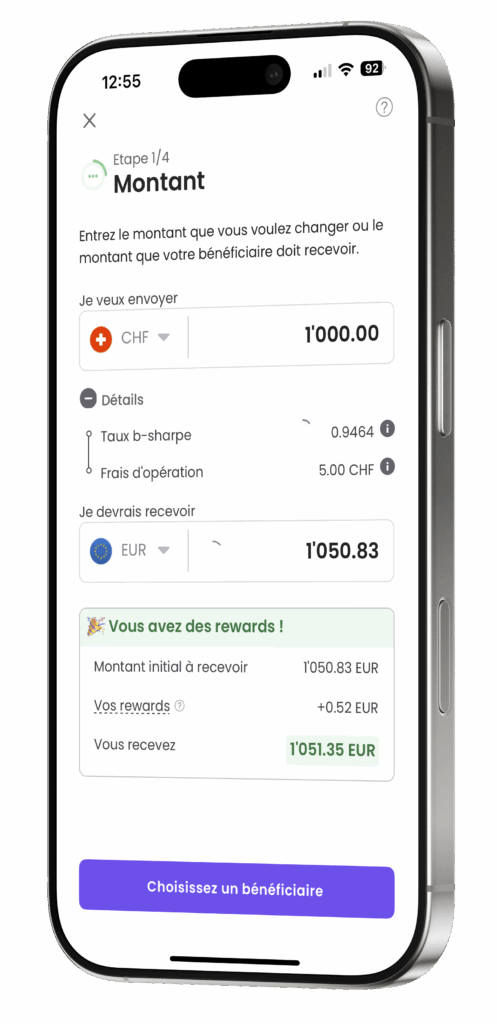
You can exchange euros for Swiss francs in cash, at a bureau de change, or by bank transfer, through your bank or an online provider. Cash is handy for small sums for a trip, but for transferring money to an account, a bank transfer is more suitable. Banks often apply an exchange margin of up to 2%, rarely shown as separate fees. With b-sharpe, you send your euros from your usual bank account to the details shown in your client area, then the conversion is carried out based on the interbank rate, with fees from 0.12% that decrease as the amount increases. Your Swiss francs are then transferred to your CHF account, and the amount you will receive is displayed before you confirm.
How can I avoid losing money when exchanging euros for Swiss francs?
The loss comes mainly from the exchange margin: when you make a transfer, banks often apply a less favourable rate than the interbank rate, with a gap of up to 2%, rarely shown as fees. First step: compare the rate you are offered with the mid-market rate shown on this converter, to measure the real gap. Next, choose a provider that starts from the interbank rate and displays its fees before you confirm: at b-sharpe, they start from 0.12% and decrease as the amount increases. Finally, for a large sum, lock your rate or set an alert so that you are not exposed to an unfavourable rate movement. Overall, you can save up to 80% on your transaction fees compared with a traditional bank.
Can I lock the rate I see now?
The online converter displays the market rate in real time without fees, for simulation purposes. To lock a rate and initiate a transaction, simply create a free account on b-sharpe. From your client area, you can lock your rate for 48 hours. You will then have full visibility of the final amount to be received, including our transaction fees (from 0.12%): no surprises, you receive exactly the displayed amount. You can also set up rate alerts to be notified when the EUR / CHF rate reaches your desired threshold.
How long does it take to receive my Swiss francs?
The timeframe varies depending on the currency, the amount and the bank receiving the funds: generally allow 1 to 2 working days between b-sharpe receiving your euros and your Swiss francs arriving. This timeframe starts when b-sharpe receives your transfer, not when you initiate the transaction. So take into account your own bank’s processing time for sending your euros, especially if you have a deadline to meet, such as rent or a deposit. Working days exclude weekends and public holidays, which can extend a transfer initiated on a Friday. In all cases, the exact amount you will receive in CHF is displayed before you confirm.
Is my money safe?
b-sharpe is a Swiss financial intermediary affiliated to SO-FIT, a self-regulatory organisation (SRO) recognised by the Swiss Financial Market Supervisory Authority (FINMA). This organisation checks that its members comply with Swiss legislation, particularly the rules on combating money laundering. The euros you send are received in a bank account domiciled in Switzerland, separate from b-sharpe’s own funds: your money is never mixed with the company’s. These funds are also covered by insurance of 5 million CHF against fraud and hacking. Finally, b-sharpe never debits anything from your accounts: you are always the one who initiates the transfer.
Is there a minimum amount to exchange currencies?
No, there is no minimum amount for a one-off transaction: you can exchange a few hundred euros as easily as a large sum. There is no subscription and no fixed fee, you only pay when you make a conversion. Transaction fees start from 0.12% and decrease as the amount increases: the larger the sum converted, the lower the percentage applied. Before each transaction, you see the exact amount in Swiss francs that you will receive. For large amounts, you can also call on b-sharpe’s desk to secure your rate.
How can I pay for a purchase or rent in Switzerland with euros?
To pay rent, a rental deposit or a property purchase in Switzerland, you generally need Swiss francs. Going through your bank for this type of international transfer often involves a high exchange margin, which weighs all the more heavily as the amount increases. With b-sharpe, you send your euros, the conversion is based on the interbank rate and your Swiss francs are transferred to the specified CHF account. For rent paid every month, rate alerts help you choose when to convert; for a large-value transfer such as a property purchase, you can lock your rate for 48 hours to secure the amount to be paid. On €100,000, a 1% difference in the rate already represents €1,000.
How do I create a b-sharpe account?
Opening a b-sharpe account is free and without commitment: you only pay when you carry out a currency exchange. For individuals, the whole registration process is done online in less than 10 minutes. For businesses, simply complete your details in 2 minutes, then an account manager will contact you within 24 hours. Once your account is open, you will find in your client area the details for sending your euros, and you can lock a rate for 48 hours or set up rate alerts.