






Between the irreversible choice of health insurance, the tax complexities that vary from canton to canton, and exchange rate charges that erode your purchasing power, becoming a cross-border worker is not something you can just wing.
By the end of 2024, more than 407,000 of you had already taken up this daily challenge.
To turn this lifestyle into a genuine financial opportunity without getting overwhelmed, thorough preparation is essential. Driving licences, tax, salary repatriation and pensions: we’ve summarised everything you need to know to make a successful move.
Let’s get straight to the point.
Swiss cross-border workers: what exactly are we talking about?
One foot in France, a job in Switzerland
Becoming a cross-border worker means choosing a bicultural lifestyle: you work in Switzerland, but your main home remains in France.
Legally, this status is governed by specific rules.
Under bilateral agreements, to be considered a cross-border worker, you must return to your home in France at least once a week.
The key to working here is a G permit. This work permit, which is essential for EU/EFTA nationals, is linked to your employment contract and is obtained by your employer from the cantonal authorities.
Whether you’re planning to work in Geneva or another canton, this status allows you to take advantage of opportunities in the Swiss job market whilst maintaining your lifestyle in France.
It’s a balancing act that requires a certain amount of organisation, particularly when it comes to managing your day-to-day life across two currencies and two administrative systems.
400,000 cross-border workers: a phenomenon that is constantly growing
Cross-border work is far from being a minor phenomenon; it is a major trend that is gathering pace.
At the end of 2024, Switzerland had around 407,000 cross-border workers, a figure that is steadily rising.
According to its latest press release (April 2026), the Cross-Border Operational Mission (MOT) states that this figure has risen to 520,000.
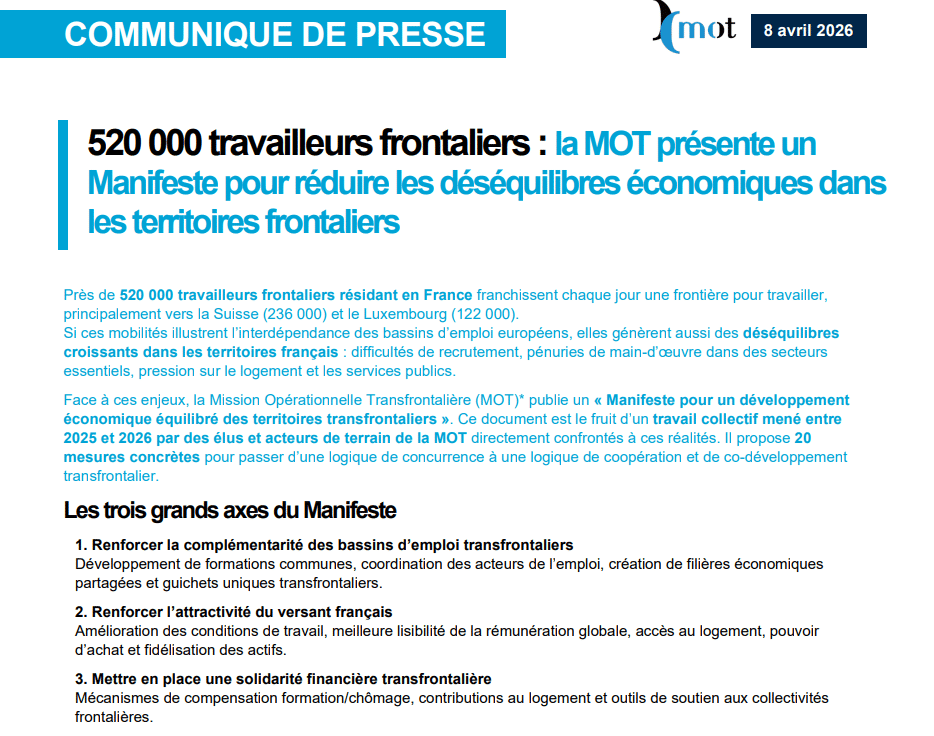
Source: Press release 2026 – MOT
France is, in fact, the main country of residence for these workers: more than 236,000 of us (around 58% of all cross-border workers in Switzerland) cross the border every day.
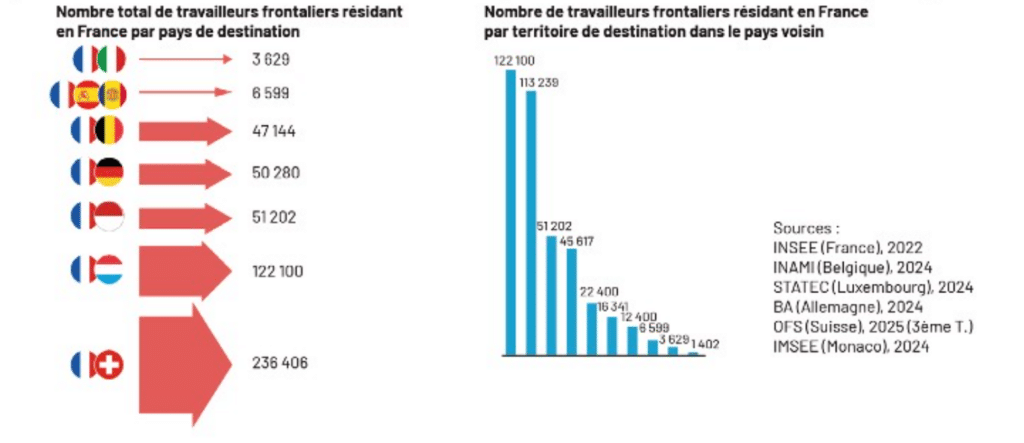
Source: Cross-Border Operational Mission (MOT) – Manifesto for the balanced economic development of cross-border regions.
This growth is particularly pronounced in the canton of Geneva, which welcomed 8,000 new cross-border workers between 2023 and 2024.
Driven by dynamic sectors such as healthcare, finance, watchmaking and manufacturing, this lifestyle is attracting an increasing number of professionals seeking new challenges, to the extent that it is permanently transforming the regions of Haute-Savoie, Ain, Jura and Haut-Rhin into genuine economic powerhouses.
How much does a cross-border worker actually earn?
This is often the first thing that strikes people: Swiss salaries are among the highest in the world.
To be specific, the average salary in Switzerland is around CHF 5,488 per month (approximately €5,734).
In some cantons, such as Geneva, a minimum wage (although not officially recognised at federal level) is in place, amounting to CHF 4,368 gross per month.
An important point to note: if we take the national median wage (across all sectors) published by the FSO in 2024, it is higher: CHF 7,024 gross per month.
Source: The median wage in Switzerland in 2024.
However, to assess what you ‘really’ earn, you need to look beyond your gross salary. Working as a cross-border worker involves costs and choices that affect your actual budget:
Expenses to be deducted from the amount paid by your employer
Currency exchange fees
Your salary is paid in Swiss francs, but your expenses are in euros. Without a competitive currency exchange solution, bank charges can eat into a significant portion of your income.
Cost of journeys
Transport is a major expense. Between vehicle maintenance, fuel and any tolls, the cost can run to between €400 and €500 a month if you drive.
Health insurance
This is a requirement. You will need to choose between the French system (CMU) and the Swiss system (LAMal). This choice, which is often irrevocable, must be based on your personal circumstances and your income level.
In short, whilst the financial benefits are undeniable, they require careful management to become a genuine driver of quality of life.
Where to start? The essential steps
The G permit: your ticket to working in Switzerland
To work as a cross-border worker, you must obtain a G permit (cross-border worker permit).
Once your contract has been signed, your employer will submit the application to the relevant cantonal office.
What you need to know in practice:
- Validity: It is generally valid for five years if you have a permanent contract or a contract lasting more than one year. If your contract is shorter, the licence’s validity period will match the duration of your employment.
- Flexibility: If you change employer or move to a different canton, your permit can be updated fairly easily, provided you remain in the cross-border worker category.
- Requirement: You must return to your home in France at least once a week.
If you’re looking for a job in Geneva, find out what you need to know about working there.
Where should you live in France if you want to work in Switzerland?
Choosing where to live is a strategic decision, as it affects your commute and your budget. The most popular areas remain Haute-Savoie (Annecy, Annemasse, Saint-Julien-en-Genevois), Ain (Pays de Gex) and Haut-Rhin for the Basel area.
To make the right choice, bear these two factors in mind:
- Transport costs: Travelling from Annecy to Geneva by car can cost between €400 and €500 a month (petrol, wear and tear, tolls).
Do consider checking whether the Léman Express or cross-border bus services are nearby to help reduce these costs. - Housing costs: The closer you are to the border, the higher the rents.
For example, a four-and-a-half-room flat in Annemasse rents for an average of around €1,870, compared with €2,320 in Viry. To find out more about moving to the area, see our guide to becoming a cross-border worker.
Working from home: how far can you go without taking risks?
Working from home has become the norm for many, but it is strictly regulated for cross-border workers to prevent any changes in tax or social security arrangements.
The current rule of thumb is the 40% threshold of annual working time.
If you stay below this limit (i.e. around two days a week), you will continue to be taxed in accordance with the standard agreements between France and Switzerland and will remain registered with the social security system of the country where you work.
If you exceed this threshold, the implications can be complex: your employer may have to pay social security contributions in France, and your tax liability may change.
So please stay alert and discuss this with your employer to finalise your remote working agreement.
Unemployment among cross-border workers: your rights if you lose your job
It’s a question that often causes concern, yet the system is well-established.
If you lose your job in Switzerland, it is France (your country of residence) that will pay your benefits, not Switzerland.
Here are the steps to follow:
- Ask your former employer and the Swiss unemployment insurance fund for form PDU1 (or E301). This document summarises your periods of employment and your contributions in Switzerland.
- Register with France Travail (formerly Pôle Emploi).
- Your benefits will be calculated on the basis of your Swiss earnings, but in accordance with French rules.
Although Swiss employment law is more flexible (it is easier to dismiss staff there than in France), the job market is very dynamic: in 2024, the average time taken to find a new job in Switzerland was estimated at less than six months.
Your salary is paid in CHF: how can you transfer it home without losing out?
Why is your employer asking you for a Swiss personal IBAN?
This is one of the first administrative procedures you will have to deal with.
In Switzerland, the vast majority of employers require your salary to be paid into a local bank account with a Swiss IBAN starting with CH.
Why this requirement? For the sake of simplicity and cost-effectiveness.
Cross-border transfers to foreign accounts (even within the SEPA area) may incur administrative charges and result in longer processing times for the company.
Having a bank account in Switzerland also makes it easier to pay your local bills (such as your KVG health insurance) and manage your direct debits. It is therefore an essential prerequisite for getting your career as a cross-border worker off to a smooth start.
The monthly habit: converting your CHF at the right rate
Once your salary in Swiss francs is safely tucked away in your Swiss bank account, the all-important question arises: how do you transfer it to your French bank account in euros?
The usual approach is to use a standard bank-to-bank transfer.
This is often the most expensive option. Traditional banks generally charge:
- Fixed or proportional transfer fees.
- A spread on the exchange rate, which is the difference between the actual market rate and the rate they offer you.
When it comes to a monthly salary, even a few pence’s difference in the exchange rate can amount to tens, or even hundreds, of euros in lost income each month.
To make the most of your budget, it is essential to compare interest rates and not let your bank dictate the cost of borrowing.
What b-sharpe actually changes on your payslip
Using b-sharpe isn’t just about switching platforms; it’s about regaining control over the value of your work.
In practical terms, for a cross-border worker wishing to work in Geneva or elsewhere in Switzerland, our service offers three immediate benefits:
- More euros for the same effort: Thanks to our highly competitive and transparent exchange rates, you’ll receive a larger portion of your net salary once it’s converted into euros.
- No hidden fees: You know exactly what you’re paying. No nasty surprises when the money arrives in your French bank account.
- Simple and quick: The process is 100% online. You can make your transfer in just a few clicks, and your funds are converted and transferred quickly.
In short, b-sharpe acts as a natural extension of your payslip: we ensure that your Swiss salary is accurately reflected in your purchasing power in France.
Taxes: France or Switzerland? The answer depends on your canton
Taxation is often a source of many questions for newcomers.
In reality, where you pay your taxes does not depend on your nationality, but on the canton where you work and the tax agreements in force.
Cantons with withholding tax: Geneva leads the way
If you work in the canton of Geneva, tax is deducted directly from your salary each month.
This is known as pay-as-you-earn tax. The employer deducts the amount due and pays it to the cantonal tax authority.
⚠️ Please note: even if you pay tax in Switzerland, you are still required to declare your income in France.
To avoid double taxation, France grants you a tax credit equal to the amount of French tax. To understand all the intricacies of this status, see our guide to becoming a cross-border worker.
💡 Good to know:
The cantons of Aargau, Zurich and Schaffhausen also apply this withholding tax rule.
The 1983 Agreement: the cantons where you pay your taxes in France
To make life easier for cross-border workers, a specific agreement was signed in 1983. It covers eight cantons: Vaud, Valais, Neuchâtel, Jura, Bern, Basel-Stadt, Basel-Landschaft and Solothurn.
If you work in one of these cantons and commute home to France every day (or at least once a week), you pay all your income tax in France.
Switzerland therefore waives the withholding tax.
To qualify for this scheme, you must provide your Swiss employer with a certificate of tax residence (form 2041-AS).
Income tax returns: the forms you need to know about
Even if you already pay tax in Switzerland, you are still required to file a tax return in France in order to determine your overall tax rate (RFR). Here are the key documents:
- Forms 2042 and 2042-C: To declare your total income.
- Form 2047: Essential for declaring your income received abroad.
- Form 2041-AS: The certificate of residence required for cantons covered by the 1983 agreement.
Remember to keep your Swiss payslips and your annual salary statement, as these will serve as supporting documents for the French authorities.
Adjustment of tax at source
For cross-border workers subject to tax at source (particularly in Geneva), the standard tax scale does not always take your actual circumstances into account (actual expenses, third-pillar contributions, maintenance payments, etc.).
You have the option of requesting a correction to your withholding tax (or applying for a subsequent ordinary tax assessment – TOU).
This must be done by 31 March of the year following the year in which your income was received.
This could enable you to reclaim some of the tax you’ve paid if you have significant deductions. It’s a technical process, but one that can often be very beneficial for your annual budget.
CMU or LAMal: a choice you can’t afford to get wrong
This is undoubtedly the most important decision you’ll make in your new life as a cross-border worker.
Unlike other decisions, your choice of health insurance is, in the vast majority of cases, irrevocable.
Take the time to do your calculations.
Three months to decide: the right of option explained
From your first day of work in Switzerland (or from the date you take up residence in France), you have three months in which to exercise your “right of option”.
This right allows you to choose between:
- The French system: CMU (Universal Health Cover) for cross-border workers.
- The Swiss system: the LAMal (Health Insurance Act).
⚠️ Please note: if you do not make your choice within this timeframe, you will automatically be enrolled in the Swiss health insurance scheme (LAMal), often with no option to change your mind.
Universal Health Cover for cross-border workers: how it works and the costs involved
The CMU (administered by the CPAM in France) is based on solidarity.
The cost is not fixed: it is calculated based on your reference taxable income (RFR).
- Cost: The contribution currently amounts to 8% of your income (after a standard administrative deduction). The higher your Swiss salary, the higher your CMU contribution.
- The advantage: This is often the most cost-effective option for cross-border workers on modest incomes or those with several dependants (children, a non-working spouse), as the contribution covers the whole family at no extra cost.
Health Insurance for Cross-Border Workers: How It Works and the Costs Involved
Unlike in France, the Swiss LAMal operates on a per-capita premium basis, regardless of your income.
- Cost: You pay a fixed monthly premium (expect to pay around CHF 160 to CHF 200 for an adult, depending on the specialist cross-border health insurance provider).
- The advantage: Mathematically speaking, this is the most cost-effective option if you have a high income, as the premium does not increase in line with your earnings. However, each family member must pay their own premium (there are no free dependants).
What do these two schemes cover?
The choice isn’t just about price, but also about the flexibility of your care:
Under the CMU
- You will receive treatment in France in accordance with the National Health Service’s rates.
- You will only be able to receive medical treatment in Switzerland in an emergency; otherwise, you will be responsible for the costs.
Under the LAMal
- You have dual cover. You can receive medical treatment in France (using your Vitale card) AND in Switzerland (for example, to see a specialist or give birth in a Swiss clinic).
- This is a significant advantage for those who wish to benefit from the proximity of Swiss medical facilities.
Pensions: how does the Swiss system work for cross-border workers?
The Swiss pension system is based on the “three-pillar” principle.
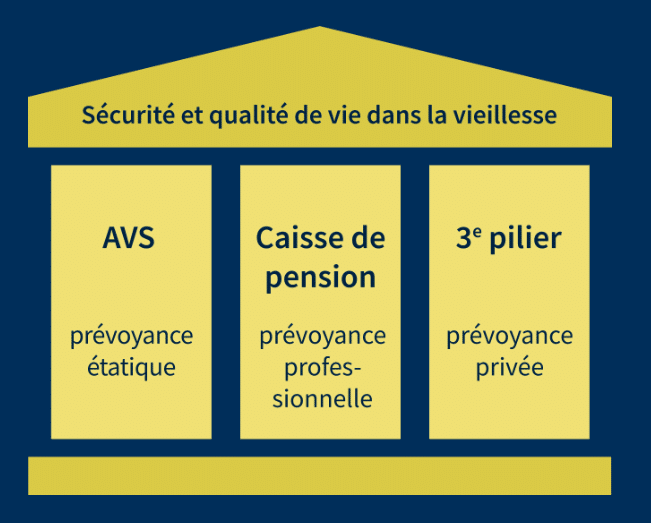
Source: www.ch.ch
Unlike the French system, it skilfully combines national solidarity with individual capitalised savings.
Pillar 1 (AVS): the basic pension
Old Age and Survivors’ Insurance (AVS) is compulsory for all workers in Switzerland. It is designed to cover basic living expenses during retirement.
- How it works: It is based on a pay-as-you-go system. Your current contributions fund the pensions of today’s retirees.
- Key point for you: To receive a full pension, you must have made contributions continuously for 21 years up to retirement age. Each missing year will reduce the amount of your future pension proportionally.
The 2nd pillar (LPP): occupational pension provision
This is where the Swiss system stands out. The LPP is a funded savings scheme managed by a pension fund (foundation) set up by your employer.
- How it works: The money you pay in (and the amount your employer contributes) is placed into a personal account. This accumulated capital belongs to you.
- Practical benefit: Under certain conditions, you can withdraw all or part of this capital early, particularly to finance the purchase of your main residence. This is a powerful tool for becoming a cross-border worker and settling in with peace of mind.
The third pillar: voluntary savings
The third pillar is a private pension scheme designed to supplement the first two pillars, enabling you to maintain your current standard of living once you retire.
- Why take it out? The first and second pillars often only cover 60% of your final salary. The third pillar bridges this gap.
- Taxation: As a cross-border worker, opting for a "3rd pillar A" scheme may allow you to deduct your contributions from your taxable income (depending on your canton and tax status), thereby reducing your immediate tax bill.
Cross-border workers earn more, but at what cost?
The prospect of working as a cross-border commuter is appealing because of the salaries, but it requires a careful balance between financial gain and quality of life.
The financial and professional benefits
Working in Switzerland means gaining access to an extremely dynamic and rewarding job market.
- Salary: This is the number one selling point. For the same role, salaries in Switzerland can be two to three times higher than those in France.
- Career progression: Swiss corporate culture values competence and offers rapid career progression for motivated individuals.
- The working environment: The facilities and working conditions (tools, management) are often of a very high standard.
The challenges of everyday life
This is where you need to be realistic so as not to burn yourself out.
- Journey time: Crossing the border can be a daily challenge. Between queues at customs and congested roads, your journey time can be extended by two to three hours. Consider the Léman Express if you’re planning to work in Geneva.
- The "hidden" cost of living: If you live in neighbouring France, rents and prices in local shops are often linked to Swiss wages. Your purchasing power may be eroded by this local inflation.
- Flexibility in employment law: In Switzerland, dismissal is much simpler and quicker than in France. Job security depends primarily on your performance.
- The 42-hour working week: The statutory working week is longer than in France (often 42 hours compared to 35). This is something you’ll need to factor into your family life.
Key takeaways:
Cross-border worker status offers exceptional financial benefits, provided you understand the rules. From managing your G permit to making strategic choices about your health insurance, every decision has a direct impact on your disposable income.
Don’t let bank charges and arbitrary exchange rates undermine all your hard work. Plan ahead, optimise your salary remittances and secure your future.
Ready to take the plunge? Start by opening your Swiss bank account and compare the options for converting your first Swiss francs at the best rate right now.
Frequently asked questions about life on the Swiss border
The national median salary in Switzerland is CHF 7,024 gross per month (FSO data for 2024).
This figure varies by canton and sector: in Geneva, for example, the minimum wage is set at CHF 4,427 gross (indexed amount for 2024) for a 40-hour working week.
We have analysed the FSO’s official press release on the Swiss median wage (gross monthly by sector of activity) to provide you with a useful summary, whatever your circumstances:
• National average (all sectors): CHF 7
,024• Senior management roles: CHF 10,
750• Non-management roles: CHF 6
,014• Simple tasks (no training required): CHF 5
,618• High value-added sectors: CHF 10,
000• Service sectors (Hospitality): < CHF
5,500 Data source: https://www.admin.ch/fr/newnsb/CzozNgBTCJOrNyvwsItyp
It all depends on the canton where you work.
In Geneva, as well as in the cantons of Aargau and Zurich, tax is deducted at source from your salary.
In the cantons covered by the 1983 agreement (such as Vaud, Valais and Neuchâtel), you pay your taxes in France.
In both cases, you are required to declare your income in France.
Your employer pays your salary in CHF into a Swiss bank account (IBAN starting with CH). To transfer this money to your French account in euros without incurring the high exchange fees charged by traditional banks, the most effective solution is to use a specialist online currency exchange platform such as b-sharpe.
You can work remotely for up to 40% of your annual working time (i.e. approximately 2 days per week) without this affecting your tax status or your social security contributions. Exceeding this threshold may result in a change of tax status in France and additional social security contributions for your employer.
Yes.
If you lose your job, you will receive benefits from your country of residence, France, in accordance with the rules of France Travail (formerly Pôle Emploi).
To claim your benefits, you must request the PDU1 form from the relevant Swiss unemployment insurance fund at the end of your contract.
Your contributions to the 1st pillar (AVS) are retained in Switzerland and will be paid to you as a pension when you reach retirement age.
For your 2nd pillar (LPP), you can either leave the capital in a vested benefits account in Switzerland or request a lump-sum payment under certain conditions (setting up a business, purchasing a main residence or leaving the European Economic Area permanently).
Working in Switzerland but living in France: the administrative formalities
What administrative procedures do cross-border workers between France and Switzerland have to go through?
The Swiss work permit
To work in Switzerland as a cross-border worker, you must obtain a Swiss work permit (Permis G). However, it is very straightforward to obtain: the application is made by the Swiss employer. They will complete the work permit application form themselves and then submit it to the Swiss cantonal authorities.
Opening a Swiss bank account
To receive your salary in Swiss francs, you will need to provide your employer with an IBAN registered in Switzerland. You will therefore need to open a bank account. You can then transfer your salary each month to a French bank account. To do this, you can use the b-sharpe currency converter. It is a reliable financial partner that will enable you to carry out all your banking transactions between France and Switzerland.
Recognition of qualifications
Have you studied abroad and would like to work in Switzerland? Whilst most professions are open to you in Switzerland – even with a qualification obtained in the European Union – others require your qualification to be recognised. Indeed, certain professions are regulated, for example in the fields of healthcare and education: doctors, dentists, pharmacists, psychologists, vets, civil engineers, teachers, taxi drivers, architects, lawyers… If you need your qualification to be recognised as equivalent, an official platform has been set up to help you.
Being a cross-border worker between France and Switzerland: pros and cons
What are the benefits of being a cross-border worker? And, conversely, what are the drawbacks of this very specific way of life?
Is it worth living in the Swiss border region?
Generally speaking, yes. Cross-border workers who live in France but work in Switzerland stand to gain significantly in financial terms. This is because wages in Switzerland are higher than in France. The Swiss job market is very dynamic: in fact, the country offers the highest wages in Europe. Living in France whilst earning a salary in Switzerland therefore offers a real financial advantage. As the cost of living in France is lower, cross-border workers save money by continuing to live in France. They can maintain their usual arrangements (children’s schooling, social life, insurance and healthcare, etc.).
The journey to work can sometimes be quite long
However, there are certain drawbacks to consider, such as journey times and longer working weeks in Switzerland. According to a study by the Jura Arc Cross-Border Statistical Observatory, half of cross-border workers spend more than 40 minutes travelling by car or public transport to get to work on the other side of the border. The Léman Express rail network serves 45 stations from France and is used by many cross-border commuters.
Labour law in Switzerland
It is also worth noting that employees in Switzerland generally work longer hours than in France. The standard working week is typically between 42 and 50 hours.
Finally, labour laws differ between France and its neighbour across the border. Legislation is more flexible in Switzerland, where employers are able to dismiss employees without cause, sometimes with very short notice periods. This is a point to bear in mind for cross-border workers, who might, for example, want to set aside some money as a financial safety net in the event of redundancy. However, it is important to note that, in the event of unemployment, cross-border workers will then be eligible for unemployment benefits in France.
FAQ: your questions about Swiss cross-border worker status
Salary, taxes, unemployment, lifestyle… b-sharpe answers your questions about the status of cross-border workers in Switzerland.
What is the salary for a Swiss cross-border worker?
How much can you earn as a cross-border worker between France and Switzerland? It all depends, of course, on the sector. However, it is important to note that the minimum wage in Switzerland is higher than in France. The amount varies by canton, but in Geneva, for example, it stands at 4,111 Swiss francs gross per month. Using a euro-to-Swiss franc converter, this works out at around 4,334 euros. However, it is worth noting that the average salary in Geneva is 6,123 euros.
Where should you live as a Swiss cross-border worker?
Where should cross-border workers settle? Ideally, a French cross-border worker should live as close as possible to the Swiss border, so they can benefit from a shorter commute… Consequently, in order to live in France whilst working in Switzerland, cross-border workers usually settle in towns near the border. Several towns in Haute-Savoie are located less than 30 minutes from Geneva. These include, for example, the towns of Annecy, Annemasse, Thonon-les-Bains and Évian-les-Bains, as well as the towns of Bons-en-Chablais, Douvaine, Veigy, Neuvecelle, Publier, Lugrin and Vétraz-Monthoux… As a result, in 2023, the Auvergne-Rhône-Alpes region was home to more than 125,000 French citizens working in Switzerland.
What about health insurance?
When it comes to health insurance, cross-border workers can choose between the Swiss scheme (LAMal for cross-border workers) and the French health insurance scheme (CMU for cross-border workers). Both schemes were created specifically for cross-border workers. Reimbursement rates are identical, and both schemes entitle the holder to a Carte Vitale. However, there are some differences: whilst the LAMal for cross-border workers provides access to healthcare networks in both Switzerland and France, the CMU for cross-border workers provides access only to the French healthcare network.
What are the tax rules for cross-border workers?
As a cross-border worker between France and Switzerland, in which country should you pay your taxes? In 1983, a tax agreement was established between France and Switzerland regarding the taxation of cross-border workers: the wages earned by these workers are taxable in their country of residence. It is therefore possible to live in France and continue to pay tax there, whilst working in Switzerland. This agreement applies in the following cantons: Vaud, Valais, Jura, Neuchâtel, Bern, Solothurn, Basel-Landschaft and Basel-Stadt. In other cantons, tax must be paid in Switzerland.
By crossing the border every day to work in Switzerland, cross-border workers enjoy favourable working conditions and often very attractive pay, whilst maintaining their lifestyle in France. What’s more, the cross-border regions offer a pleasant living environment, nestled in the heart of the mountains. However, these cross-border workers follow a rather unique routine, which may not suit all employees. Living in one country and working in another requires a fair amount of organisation: finances, taxes, regulations, insurance… Especially as France and Switzerland do not use the same currency. To support them with all their financial transactions between France and Switzerland and to exchange currencies online, b-sharpe offers a 100% online, reliable and intuitive currency converter.
Why choose to work in Switzerland?
Living in France but working in Switzerland, crossing the border every day… This way of life offers many advantages, both financial and professional.
The benefits of working as a cross-border worker in Switzerland
What are the advantages of working in Geneva and living in France? First of all, working in Switzerland and living in France offers numerous financial and professional benefits. The Swiss job market is very dynamic and salaries there are the highest in Europe. In January 2023, the minimum wage in the canton of Geneva stood at 4,368 Swiss francs gross, or 4,400 euros. Compared to French wages, Swiss pay is therefore very attractive. Certain sectors, such as finance, chemicals and the pharmaceutical industry, are actively recruiting.
By living in France whilst earning a salary in Switzerland, cross-border workers can make real savings. Indeed, the cost of living in Switzerland is very high. Housing, transport, food, leisure activities… Everything is more expensive in Switzerland than in France. Cross-border workers can also maintain their routines and family life in France, for example by sending their children to school there.
The downsides of working as a cross-border worker in Switzerland
However, living as a cross-border commuter does have its drawbacks. Living in France and working in Geneva means spending time in the car or on public transport every day to get to Switzerland. According to a study by the Jura Arc Cross-Border Statistical Observatory (OSTAJ), half of cross-border workers (also known as commuters) take more than 42 minutes to get to work each day. Most of them work more than 35 km from their homes. Finally, it is important to note that the working week is not fixed, as it is in France. Swiss workers work longer hours, with a typical working week of between 42 and 50 hours.
Where should you live in France if you work in Geneva?
Where do cross-border workers live in France? Which are the best towns to settle in for easy access to Switzerland for work? In the Auvergne-Rhône-Alpes region, in 2023, there were more than 125,000 French citizens working in Switzerland… The towns closest to Geneva are home to a large number of cross-border workers: Annecy, Annemasse, Thonon-les-Bains, Évian-les-Bains, Bons-en-Chablais, Douvaine, Veigy, Neuvecelle, Publier, Lugrin, and Vétraz-Monthoux… Surrounding Lake Geneva, these towns in Haute-Savoie are all located less than 30 minutes from Geneva! They are therefore highly sought-after by cross-border workers, not only for their proximity to Switzerland but also for their quality of life. The surrounding natural landscape, with its lakes and mountains, makes for a unique living environment, ideal for both couples and families.
Living in France and working in Geneva: practical considerations
Living in one country but working in another: becoming a cross-border worker requires a certain amount of organisation. What are the administrative formalities involved in cross-border work in Switzerland? To become a cross-border worker between France and Switzerland, the administrative formalities are relatively straightforward. Work permits, taxation, insurance… Here is the information you need to know to be able to work in Switzerland with peace of mind, whilst living in France.
Currency and foreign exchange
As a reminder, Switzerland is not part of the eurozone. The local currency is the Swiss franc. Whether you’re working in Switzerland and need to make purchases there, or simply want to convert your salary into euros, b-sharpe offers a reliable euro-to-Swiss franc currency converter that is updated in real time, highly intuitive and easy to use.
The Swiss work permit
In order to work in Switzerland as a cross-border worker, all EU citizens must hold a Swiss work permit, or G permit. This is essential for working in Switzerland. It is very easy to obtain: the application is made by the Swiss employer, who will complete the work permit application form themselves and submit it to the Swiss cantonal authorities. In the case of a permanent contract, the G permit is valid for 5 years. The conditions for obtaining a G permit are as follows:
- hold a Swiss employment contract or a letter of offer;
- already be employed by a Swiss company;
- return to their home outside Switzerland at least once a week.
Opening a Swiss bank account
In order to receive your salary in Swiss francs, your employer will ask you for an IBAN registered in Switzerland. You will therefore need to open a bank account. You can then transfer your salary each month to a French bank account. The b-sharpe currency converter is a trusted financial partner for all your banking transactions between France and Switzerland.
The Swiss insurance system
When working in Switzerland, French cross-border workers are no longer covered by the French general social security scheme, nor by their mutual insurance or supplementary insurance in France. To obtain cover, cross-border workers must choose between the French scheme (CMU) and the Swiss scheme (LAMAL).
Recognition of qualifications
Have you studied abroad and would like to work in Switzerland? Good news: the Swiss education system is similar to that of European Union countries. This means that most professions are open to you with a degree obtained within the EU. If you obtained your degree outside the EU, you will need to apply for academic recognition. However, it is important to note that certain professions are regulated, particularly in the fields of healthcare, education, etc. In such cases, recognition of your qualification will be required. Here are some examples of regulated professions in Switzerland: doctor, dentist, pharmacist, psychologist, vet, civil engineer, teacher, taxi driver, architect, lawyer… If you need your qualification to be recognised as equivalent, an official platform has been set up to help you.
Taxes
And what about taxation? How is tax calculated in France for cross-border workers? As Switzerland is a federal state, each canton is free to set its own tax rules for cross-border workers. Some French nationals working in Switzerland can continue to pay their taxes in France. Since 1983, an agreement has been in place between France and Switzerland regarding the tax regime for cross-border workers: the wages earned by these workers are taxable in their country of residence. Thus, it is possible to live in France and pay taxes there, whilst working in Geneva. This agreement has been adopted in the following cantons: Vaud, Valais, Jura, Neuchâtel, Bern, Solothurn, Basel-Stadt and Basel-Landschaft. And in Geneva? Please note that if you work in Geneva, you will pay your taxes in Switzerland, i.e. in your country of employment.
Cross-border mobility
For cross-border workers, living in France but working in Geneva means spending a lot of time travelling. If you plan to drive on Swiss motorways, remember to buy a Swiss vignette, which is the motorway toll sticker. Available in either physical or digital form, this essential pass allows you to drive legally on Swiss roads.
Living in France but working in Geneva? It’s possible! Many French people have decided to move to Switzerland to work and live there. Others have chosen to continue living in France, close to the border, so they can commute to their employer in Switzerland. The rise of remote working has also made life easier for these cross-border workers. By the end of 2022, 380,000 people were crossing the French-Swiss border daily to work in neighbouring Switzerland, according to the Federal Statistical Office. b-sharpe offers cross-border workers the option to exchange currencies online and transfer their Swiss salary, whilst benefiting from a transparent exchange rate. To avoid having to open a second bank account in Switzerland, they can then transfer their salary directly back to France.
The Swiss vignetteWhat is the Swiss vignette?
In Switzerland, motorists must pay a motorway toll to use motorways and expressways. To do so, they must purchase the famous “Swiss vignette”. Available in physical or digital form, this essential pass allows you to drive legally on Swiss roads.
History
The vignette was introduced in Switzerland in 1984, making it the first country in Europe to introduce such a motorway vignette, available either in physical form—as a sticker to be affixed to the windscreen—or in electronic form. Since 1 August 2023, the Swiss vignette has also been available in a digital version, which can be purchased very easily online.
Price
The Swiss motorway vignette costs a one-off fee of 40 francs, which is currently 40.70 euros (based on the current exchange rate provided by the Swiss franc–euro converter on b-sharpe). Online, the vignette costs 44 francs.
An activation fee of 10 francs is added to this base price.
Validity
The Swiss vignette is valid for the current year. For example, the 2025 vignette is valid from 1 December 2024 to 31 January 2026. There are no daily, weekly or monthly vignettes.
Which vehicles are subject to the Swiss motorway toll sticker?
The Swiss motorway toll applies to cars, motorbikes, trailers and caravans, as well as lorries and motorhomes (up to 3.5 tonnes).
Where can I buy a Swiss vignette?
There are many places in Switzerland where you can buy the vignette. It is available at petrol stations, post offices, some garages and customs offices at the border. You can also buy it at outlets located before the border.
You can also buy it online: on the Swiss Post website, as well as on the Federal Office for Customs and Border Security (OFDF) portal at www.e-vignette.ch.
Can you drive in Switzerland without a motorway toll sticker?
If you drive on motorways and expressways without a vignette, you will be liable to a fine of 200 Swiss francs. You will also have to pay for the vignette (which costs 40 francs).
How are vignettes checked in Switzerland?
Your vignette must be displayed inside your vehicle, on the windscreen, so that it is clearly visible during checks. On vehicles without a windscreen, such as trailers, it must be displayed in a clearly visible position.
During a roadside check, the presence and validity of the vignette will be checked. For the digital version, your number plate will be checked during a roadside check. This is linked to your digital vignette.
A ‘physical’ vignette or a digital vignette: which should you choose?
Is there a difference between the standard adhesive vignette and the digital vignette? In fact, the vignette purchased online is linked to the vehicle’s number plate, which is not the case with the adhesive vignette. This means that if you change vehicles, the vignette will remain valid.
How to drive safely in Switzerland?
Is this your first time driving in Switzerland? Once you’ve got your Swiss vignette, you’re ready to hit the road. Please note that the rules for driving and parking are not the same as in France.
Here is some practical information:
- The speed limit on motorways in Switzerland is 80 km/h, compared with 110 km/h in France;
- On Swiss motorways, the speed limit is 120 km/h;
- When approaching pedestrian crossings, drivers must stop, even if there are no pedestrians crossing. Slow down when approaching pedestrian crossings;
- Since 1 January 2014, drivers have been required to switch on their dipped headlights at all times, both day and night;
- the maximum permitted blood alcohol level is the same in France as in Switzerland (0.5 g/L);
- The use of mobile phones whilst driving is prohibited in Switzerland.
Are you travelling or on holiday in Switzerland? To plan your journey properly and avoid a fine, buy your motorway toll sticker online or at a sales point so you can drive freely on Swiss motorways. During your stay in Switzerland, you’ll no doubt need a currency converter. b-sharpe supports you with all your financial transactions, making it very easy to exchange currencies online!
Opening a bank account in SwitzerlandReceiving your salary, paying bills or rent… Opening a Swiss bank account will certainly make all your financial arrangements (salaries, bills, rent) much easier once you’re there! Plan ahead by finding out about the banks and the various options available to you. In this article, b-sharpe, your currency exchange partner, explains everything you need to know about opening a bank account and Swiss banks.
Opening a bank account in Switzerland: a quick and easy process
Opening a bank account in Switzerland is easier than you might think. For French expats or cross-border workers, the process is usually quick. What are the requirements for opening an account in Switzerland? What supporting documents are required? Find out below.
Good to know: some Swiss banks, such as UBS and Credit Suisse, have branches in France where you can open a bank account.
How to open a bank account in Switzerland
When you open your new bank account in Switzerland, you will, of course, need to provide certain documents to your new bank. Whilst the required documents may vary from bank to bank, you will always be asked to provide:
- Proof of identity, such as a passport or national identity card;
- Proof of address (an electricity, internet or water bill, etc.)
- Bank statements;
- Proof of employment in Switzerland;
- Proof of income.
Is it possible for a French citizen to open a bank account in Switzerland?
Can I open a bank account in Switzerland if I am a French national? Absolutely. It is legal for French nationals to open a bank account in Switzerland. However, you are required to declare any bank accounts held abroad to the French tax authorities and to include them in your annual tax return.
Can you open a bank account in Switzerland if you are a non-resident?
Do you live in France or elsewhere abroad, outside Switzerland, and wish to open a bank account in Switzerland? It is possible! However, some banks may ask you to make a substantial deposit, or require you to provide proof of income to demonstrate your creditworthiness. Furthermore, the tax authorities in your country of residence must be notified of the opening of a foreign bank account. Your Swiss bank will therefore have to send a list of all transactions carried out to the tax authorities in your country every year.
Is it possible to open an account online?
Good to know: you can open a bank account in Switzerland online or remotely. However, you will need to submit all the necessary documents online or by post, depending on the option you choose.
Everything you need to know about banks in Switzerland
As you’re no doubt aware, Switzerland is the banking capital of the world! There’s therefore a wide range of banking options available… From traditional players such as PostFinance, Credit Suisse and UBS to neobanks like Swissquote and Yuh… How do you make sense of it all? Here are the key factors to consider when choosing your banking partner, before opening an account in Switzerland.
The advantages of Swiss banks
Why open a bank account in Switzerland? The Swiss banking system is renowned worldwide… Swiss banks offer a number of advantages:
- Greater security for funds: the Swiss financial landscape is one of the most heavily regulated in the world. Financial regulators impose strict rules on banks, particularly regarding the protection of funds and banking secrecy. Indeed, national law stipulates that banks may under no circumstances disclose their clients’ financial information.
- A world-renowned financial system: the Swiss financial centre offers banking services of the highest standard. This applies not only to traditional banks but also to private banks specialising in wealth management.
- Economic stability at national level: as you know, Switzerland is an economically stable country. Wages and the standard of living are very favourable. The Swiss minimum wage is among the highest in the world. The pension system (Swiss LPP) is also robust. Banks therefore benefit from a favourable political and economic climate.
Opening a bank account in Switzerland: how to choose the right bank?
Which is the best bank to open an account with in Switzerland? It’s hard to say, given the sheer number of banks in the country! They offer a range of services and tailor their offerings to their customers’ needs. Switzerland is a federal and multilingual state. As such, there are several types of banking institutions:
- Universal banks, which operate nationwide;
- Local banks operating at cantonal level;
- Co-operative banks;
- Private banks, which specialise in wealth management;
- Online banks (neobanks).
Are you looking to open a current account (also known as a salary account) in Switzerland? If so, universal or cantonal banks will undoubtedly be the most suitable option. Finally, there is another option available to you: online banks. Flexible and paperless, they often charge lower bank fees.
Are you a cross-border worker living in France? You should know that some Swiss banks offer so-called “cross-border” accounts, specifically designed for this particular status! These accounts offer few options, as they are designed solely to receive your salary and transfer it to a French account in euros. This is an advantageous and less expensive solution for having your salary paid in Swiss francs (CHF). However, you should check with your employer before opening a cross-border account with a French bank: some Swiss employers require a Swiss IBAN for salary payments.
The issue of bank charges
What are the costs associated with debit and credit cards? Bank charges in Switzerland are relatively high. This is an important point to bear in mind before opening a bank account in Switzerland. Be sure to compare the offers from different banks.
The amount of the monthly account maintenance fee varies from bank to bank. On average, it amounts to 20 Swiss francs for a current account that includes a debit card. The more features and services your bank account includes, the higher the fees will be. Withdrawals from ATMs (also known as Bancomats in Switzerland) belonging to your chosen bank are generally free of charge. Some banks charge a fee if you withdraw from a Bancomat belonging to another bank. International transfers or withdrawals abroad may also be subject to charges. The same applies to overdraft charges.
Finally, if you travel regularly within the eurozone or are a cross-border worker, consider choosing a bank that allows you to withdraw cash in both euros and Swiss francs. However, you can still exchange currencies online easily and at preferential rates using a euro-to-Swiss franc converter such as b-sharpe.
FAQ
Are you a cross-border worker or an expat looking to open a bank account in Switzerland? b-sharpe has all the answers to your questions about opening a bank account in Switzerland.
What are the requirements for opening a bank account in Switzerland?
Opening a bank account in Switzerland is a very straightforward process. This applies even to non-residents. What are the requirements? You must be of legal age, provide a work permit (or G permit), proof of identity and proof of address, as well as a statement explaining the source of your funds. Please note that US citizens may only open a Swiss bank account under certain conditions.
Can I open a business bank account in Switzerland as a French national?
Technically, yes. But that means your business must be registered in Switzerland. Switzerland offers many advantages for entrepreneurs, including a simplified administrative framework and faster processing times compared to France. However, certain eligibility criteria must be met to set up a business as a foreign national. Therefore, it is essential to hold a residence permit (type B or G) or to partner with a Swiss resident in order to legally establish a company in the country.
Setting up a business, and therefore opening a business bank account in Switzerland, can be more complicated for non-Swiss residents due to strict compliance requirements. Swiss banks scrutinise the source of funds and the business sector very closely. It is advisable to seek professional assistance to streamline this process and ensure compliance with Swiss banking regulations.
Can a French citizen open a bank account in Switzerland?
Yes, a French national can certainly open a bank account in Switzerland. However, the situation may vary depending on their residency status (residence permit, cross-border worker status, non-resident). Please contact a Swiss bank for further information.
Can you open a bank account in Switzerland for free?
Yes and no. Traditional Swiss banks charge account maintenance fees, so it is not possible to open an account with them for free. However, some online banks (or neobanks) based in Switzerland offer free account openings. You will then have a Swiss IBAN in CH. Some fees or services will subsequently incur a charge. Their services are provided entirely online. Please note: make sure you check carefully beforehand, as these banks are not always compatible with receiving your Swiss salary. Some employers require accounts with traditional banks. However, neobanks are still useful for holding a secondary account.
How can I convert my Swiss francs into euros without a Swiss bank account?
If you live or work between France and Switzerland, you will no doubt need to regularly convert currency between euros and Swiss francs, and vice versa. To exchange your currency, there are several options available to you, such as traditional banks or bureaux de change, financial institutions specialising in foreign currency conversion. It is also possible to exchange your euros or Swiss francs, as well as many other currencies, directly online. b-sharpe offers an online currency converter, updated in real time, for all your transactions. Take advantage of competitive rates to carry out your online currency exchanges in over 20 currencies: Swiss francs to euros, Swiss francs to pounds sterling, or even dollars to euros…
b-sharpe allows you to benefit from a very competitive exchange rate compared to traditional providers. The rate offered for EUR-CHF or CHF-EUR conversions is therefore significantly lower than that of a traditional bank. Every transaction is carried out with complete transparency. The fees applied to each transaction are clearly stated before each conversion. b-sharpe guarantees its users transparency and security.
To live in Switzerland, opening a local bank account is essential. But to help you settle in Switzerland and manage your finances, you will also need a currency converter. b-sharpe supports you in all your transactions, enabling you to exchange currencies online easily, reliably and transparently.
Fixing the Swiss franc exchange rate: a false economy?Did you know that some banks offer the option to fix the exchange rate? This allows you to benefit from a favourable rate for longer and means you no longer have to worry about fluctuations in the Swiss franc exchange rate. But is fixing the exchange rate a good idea? b-sharpe explains everything in this article!
The exchange rate of the Swiss franc
What is the exchange rate for the Swiss franc? As you are no doubt aware, exchange rates – including that of the Swiss franc – are constantly changing. They fluctuate on a daily basis on the Forex market. There are many factors that cause the Swiss franc, and all other currencies, to fluctuate:
- The specified period
- The economic climate
- Monetary policy pursued by central banks
- Investor reaction
- The price of energy resources…
But how can you tell whether an exchange rate is favourable or not? To find out whether the exchange rate you’ve been offered is favourable – and thus determine whether the margin charged by your financial intermediary is too high – you can compare it to the reference rate (or ‘interbank rate’). This is the rate at which banks trade with one another. You can find it on all financial data websites.
With innovative financial intermediaries, you can exchange currencies online and benefit from competitive exchange rates compared to those offered by traditional providers such as banks or currency exchange bureaux.
How to lock in the Swiss franc exchange rate: the forward contract
For all your financial transactions between France and Switzerland (transferring your salary, making bank transfers, etc.), you need to take the exchange rate into account and find the best time to make your transfers, so as not to lose out on the exchange rate. Some people have decided to opt for a fixed exchange rate. This is known as a forward sale.
What exactly is a futures contract?
A forward sale is a contract entered into between an individual and a bank. It allows the exchange rate to be fixed at a rate that will apply to all currency conversions for a specified period. This period is usually set at 3, 6 or 12 months. Thus, when converting Swiss francs into euros, a forward sale commits the customer to selling a certain amount of Swiss francs to their bank each month in exchange for a certain amount of euros, at the rate specified in the contract.
Fixing your Swiss exchange rate: pros and cons
At first glance, fixing the exchange rate seems very advantageous. In particular, it allows you to benefit from a favourable rate for longer and means you no longer have to worry about fluctuations in the Swiss franc exchange rate. For an individual, this therefore provides protection against any unfavourable changes in the exchange rate. They no longer need to monitor exchange rates or look for the best time to carry out their transactions, as their bank handles the conversion.
However, this process has undeniable drawbacks. Firstly, the individual agrees a rate with their bank and will therefore be unable to benefit from a more favourable rate should market conditions improve. Furthermore, fixing the rate comes at a cost: the bank charges an administration fee and applies a margin on transactions that can sometimes be substantial. Finally, the bank may charge fees and penalties if you do not pay your salary into the account by the agreed deadline. With a forward sale, the customer is contractually obliged to make monthly payments to their bank. However, if life’s uncertainties (financial difficulties, unexpected expenses, redundancy) prevent them from paying the amounts due, the bank may claim penalty charges. Fixing the exchange rate therefore presents a financial risk that should not be overlooked.
b-sharpe, an alternative to exchange rate pegging in Switzerland
Fortunately, there are other ways to take advantage of a favourable exchange rate for all your currency conversions without having to lock in a rate (or use forward sales). b-sharpe, an online currency converter, offers you a cost-effective, user-friendly, fast and secure solution for all your currency exchanges, with reduced exchange fees.
A reliable and secure online currency converter
b-sharpe customers can lock in their exchange rate in real time and have 48 hours to complete their transaction.
Monitor rates with alerts
With b-sharpe, receive alerts when your currencies reach your desired exchange rate, and track the movements of more than 20 currencies. Set up exchange rate alerts in your customer portal and be notified at the best time to carry out your transactions.
How does b-sharpe’s CHF/EUR currency exchange service work?
The b-sharpe currency converter stands out for its ease of use! It takes just three steps to convert your Swiss francs into euros.
- Set up the transaction in your b-sharpe customer portal: provide details of your transaction and specify the amount you wish to exchange in the target currency, as well as the account into which the funds will be paid.
- Sending funds to b-sharpe from your bank account: using your banking app, make a bank transfer to b-sharpe’s IBAN, which you can download from your customer portal or find in your exchange confirmation
- b-sharpe processes the transfer in the target currency: as soon as we receive your funds, they will be converted and sent to the recipient’s account!
With an innovative, 100% online service, b-sharpe is your go-to partner for all your euro-to-Swiss franc transactions or dollar-to-Swiss franc conversions.
Moving to Switzerland: everything you need to know about living abroad with b-sharpeHow do you move to Switzerland if you’re French? Is it easy to move to Switzerland? What steps do you need to take? b-sharpe tells you everything in this article!
Why choose Switzerland?
Switzerland is a prime destination for expats and for those wishing to study abroad. The country offers undeniable advantages and an incredible quality of life:
- Switzerland is a safe and politically very stable country
- Its infrastructure is of a high standard, as is its transport system
- The labour market is buoyant, with very high wages
- The minimum wage in Switzerland is among the highest in Europe
- Switzerland is a real haven for expats: it is a multicultural and cosmopolitan nation with four official languages. For French speakers, it is an ideal destination.
- It offers an ideal environment for families. The healthcare and education systems there are of a particularly high standard
- Switzerland is a country blessed with incredible natural resources, magnificent landscapes and a wealth of opportunities for tourism. Lakes, mountains, winter sports or hiking… The possibilities are endless.
Living in Switzerland
However, living in Switzerland does have some significant drawbacks that should be taken into account before moving there.
A high cost of living
The cost of living in Switzerland is particularly high, and prices are steep across the board. Housing, transport, food… Switzerland is considered the most expensive country in Europe. Two Swiss cities feature in the top 10 most expensive cities in the world: Zurich (4th) and Geneva (7th). According to a study by the Federal Statistical Office, the general price level in Switzerland is nearly 60% higher than the European average. How can this be explained?
- Salaries in Switzerland are very high. The cost of living is correspondingly high
- Switzerland is not part of the eurozone and the Swiss franc is a strong currency. Imported goods are therefore more expensive for foreign visitors
- Population density is very high in major cities such as Zurich, Basel and Geneva, driving up house prices. For example, the price per square metre in Switzerland is on average 50% higher than in France
- Switzerland tends to favour its domestic economy through protectionist policies, such as customs duties and import taxes.
Working in Switzerland
Are you thinking of moving to Switzerland? Here is some useful information about the local job market.
Salaries
It’s no myth: wages in Switzerland are significantly higher than in the rest of Europe. The minimum wage in the canton of Geneva is 4,368 Swiss francs gross, or 4,400 euros. According to the OECD, the average wage in Switzerland in 2023 was 62,379 Swiss francs gross per year. When converted using a euro-to-Swiss franc converter, this equates to 65,349 euros per year.
Unemployment and employment in Switzerland
Switzerland has an exceptionally low unemployment rate! It currently stands at around 2%, its lowest level in 20 years. Today, Switzerland is one of the most stable labour markets in Europe. Many sectors are actively recruiting:
- Finance, of course, given that Switzerland is a major international financial centre. It is an incredible source of job opportunities, attracting candidates from all over the world and offering very high salaries.
- Health and the pharmaceutical industry
- The watchmaking industry, a flagship of the Swiss economy with a global reputation
- Tourism, the hotel industry, and the catering sector
- Engineering: Switzerland is looking for engineers specialising in mechanical engineering, construction, energy or the environment
- New technologies
- Business services or consultancy, with a large number of major global companies operating in Switzerland.
Switzerland welcomes foreign workers, although competition for certain roles can be fierce. Whilst there are some job vacancies available without a degree or qualifications, these are far fewer in number.
Taxes
As far as taxation is concerned, it is worth noting that the average tax rate in Switzerland is 40%. Swiss tax rates are therefore lower than those in France. They are divided into three categories:
- Federal tax at national level
- Cantonal tax at regional level
- Local council tax, payable to the local council where you live.
Tax is deducted at source by the employer. However, tax rates vary depending on the canton of residence, family circumstances and salary: some cantons have a tax rate of 20%, whilst others have rates as high as 43%.
Some Swiss cantons also offer foreign residents who meet certain criteria a tax system known as the lump-sum tax. This scheme is particularly advantageous for high-income earners or those with substantial assets, as it calculates the taxable amount based on the taxpayer’s expenses rather than their income. Expenses related to housing, food, transport and leisure are therefore taken into account. The lump-sum tax system is therefore a sensible option for certain types of expatriates!
Formalities and other information you need to know before moving to Switzerland
Are you thinking of moving to Switzerland? Here is some useful information to help you prepare for your move.
Swiss residence permits
European nationals do not require a visa to move to Switzerland, but they do need authorisation to stay for more than 90 days. Foreign workers must be issued with a residence permit or work permit. There are several documents known as ‘livrets’:
- The L permit: valid for one year and renewable, it is intended for jobseekers or employees who have signed an employment contract of less than one year’s duration
- The B permit: valid for five years and renewable, it allows employees who have signed an employment contract of more than 12 months to reside in Switzerland. It is also available to people who are not in employment but have sufficient financial means to live in Switzerland
- The C pass: valid indefinitely, it is intended for people who can prove they have lived in Switzerland for five years without interruption
- Booklet G: this applies to cross-border workers and is valid for five years.
- Students enrolled at a Swiss higher education institution are granted a residence permit for the duration of their studies, provided they have sufficient financial means and health insurance.
- Retirees are granted a five-year renewable residence permit, provided they have sufficient financial means and health and accident insurance.
Other essential formalities
Before moving to Switzerland, remember to notify the French tax authorities of your move! This will ensure you are in good standing and avoid being subject to double taxation.
Drivers, please remember to exchange your driving licence for a Swiss one. After all, once you have been living in Switzerland for more than three months, your French licence no longer entitles you to drive in the country.
Finally, anyone moving to Switzerland must notify their local council of their arrival within eight days. You must also register your arrival before your first day of work in Switzerland. Please contact your local council’s administrative services.
Is it easy to move to Switzerland? As in many countries, the process of moving abroad requires careful consideration and takes time. In Switzerland, the administrative formalities are quick to sort out, but you may encounter certain difficulties. The job market is competitive, and housing prices and the cost of living are high… However, life in Switzerland is particularly appealing and you’ll enjoy an unrivalled quality of life! To help you with the process and your finances, you will no doubt need a currency converter. b-sharpe supports you with all your transactions, so you can easily exchange currencies online!
The three-pillar system in Switzerland
First and foremost, it is important to note that the social security and pension system in Switzerland consists of three components, known as pillars. To recap, they are as follows:
- The first pillar is compulsory social insurance. It consists mainly of the Old Age and Survivors’ Insurance (AVS) and federal disability insurance (AVS/AI). There are also supplementary benefits (PC) for people with additional needs.
- The second pillar covers occupational pension provision and retirement insurance. It is governed by the Federal Act on Occupational Pension Provision, or LPP.
- The third pillar relates to private pension provision. It is optional and allows individuals to supplement their second pillar in order to build up retirement savings. The third pillar is divided into several types, A or B, based on either banking or insurance models.
In short, it’s quite simple: in Switzerland, once you retire, the first pillar covers basic living expenses, the second pillar helps maintain your usual standard of living, and the third pillar is an individual, personal supplement.
Is the AVS part of Switzerland’s first pillar?
A closer look at the AVS, which forms part of Switzerland’s first pillar.
What is the AVS?
What does AVS stand for? It is the acronym for Old Age and Survivors’ Insurance. Its purpose is to enable insured persons to retire from working life with greater peace of mind and financial security. It is a compulsory old-age pension for everyone. There is also a survivors’ pension for families, to protect them from financial hardship in the event of the death of a loved one.
How does the AVS work?
The AVS is a traditional pay-as-you-go pension scheme. How does it work? It is based on intergenerational solidarity, ensuring that all Swiss citizens and workers have a guaranteed income in retirement.
Who funds the AVS? Pensions are made possible by contributions from the working population, who, in turn, will benefit from the contributions made by younger workers once they reach retirement age. Thus, employers and employees, as well as the self-employed, constitute the main sources of income for the AVS. The Swiss Confederation also contributes. A portion of value added tax (VAT) and casino tax (gambling establishments) is allocated to funding the AVS. When working in Switzerland, AVS contributions are deducted directly from your salary during your period of employment.
How much is the AVS?
How much is the AVS pension in Switzerland? The amount depends on the length of contribution and the worker’s income. Other factors may also be taken into account, such as contribution credits or gaps in contributions…
Maximum and minimum amounts
In 2023, the maximum AVS pension is CHF 2,450 per month for a single person and CHF 3,675 for a married couple.
However, to receive the maximum pension, two conditions must be met:
- You must not have any gaps in your AHV contributions
- Have an average annual income of at least CHF 88,200
Finally, the minimum monthly AVS pension amounts to CHF 1,225 per person.
Methods of calculating the AVS in Switzerland
If you work in Switzerland, how much do you need to pay in contributions? It depends on your circumstances:
- If you are not currently in employment, are a student, are in early retirement, or are on disability benefit, you are required to pay a minimum annual contribution of CHF 514 to the AVS. If you are married and your spouse is able to pay double the minimum annual contribution (i.e. 514 x 2 = CHF 1,028), then you will not be required to pay any contributions.
- If you are an employee, you will need to pay 8.7% of your salary into the AVS. Your employer will deduct your contributions from your salary and pass them on to the compensation fund.
- If you are self-employed, you will need to pay your AHV contributions yourself. These amount to around 8% of your income.
How is the AVS pension calculated? Your local AVS compensation fund can calculate the amount of your pension for you. This service is free of charge for those aged 40 and over. The fund will check the various accounts held in your name with all cantonal funds and calculate the amount of your future pension based on your contribution periods.
Bonuses
Under the AVS scheme, there are various allowances that affect the amount of the pension and the contributions. The child-rearing allowance is available to parents with dependent children. The care allowance is intended for people with elderly or sick parents in their care.
Gaps
Gaps in contributions are another important factor to bear in mind. If contributions are not paid regularly to the AVS, this is referred to as a contribution gap. Each missing year of contributions (due to unemployment, a stay abroad, years spent studying, or an employer’s failure to pay, for example) results in a reduction in the pension.
Who is entitled to an AVS pension?
In Switzerland, all workers, whether Swiss nationals or not, are covered by the AVS.
Retirement in Switzerland: statutory retirement age
How many years do you need to contribute to qualify for a full AVS pension? Depending on the statutory retirement age in Switzerland, a woman must currently contribute to the AVS for 43 years and a man for 44 years. Please note that even people who are not in gainful employment must contribute for this period!
In Switzerland, the AVS is therefore paid to all workers who reach the statutory retirement age: 64 for women and 65 for men. However, you must have at least one year of contributions to your name.
And what about early retirement, before the standard retirement age? It is possible to claim your AVS pension early, for a maximum of two years. However, a reduction of 6.8% is applied to your old-age pension for each year you retire early.
The Swiss Old Age and Survivors’ Insurance (AVS): the case of cross-border workers
Are you one of the nearly 380,000 people who live in France but work in Switzerland? As cross-border workers employed in Switzerland, you are covered by the AVS and must also pay contributions. The amount of your pension will then be proportional to the number of years you have contributed in Switzerland. If you are approaching retirement age, you should be aware that you will be eligible for your Swiss AVS pension. Depending on your career history, there are several possible scenarios:
- If you are not a Swiss national but have spent your entire working life in Switzerland (even as a cross-border worker), you will only be entitled to an AVS pension during your retirement.
- If you have also worked in France (or any other European Union country), you will be entitled to a combination of a French pension (or a pension from another Member State) and the Swiss AVS, provided you meet the eligibility criteria in both countries. Each country in which you have worked will pay you your share of the pension.
How do you apply for a Swiss old-age pension? You must submit a written application to the AVS compensation fund to which you paid your most recent contributions. These cantonal bodies will be your main point of contact for all matters relating to the AVS.
If you live in France and have worked in Switzerland, you will likely need to use a euro-to-Swiss franc converter when you start receiving your Swiss pension. Would you like to repatriate the money from your various pension pillars from Switzerland? b-sharpe is here to help! What do we guarantee? A streamlined process and favourable exchange rates, thanks to our online currency converter.
The cost of living in Switzerland: is it the highest in Europe?A closer look at the cost of living in Switzerland
You may have experienced this yourself whilst living in Switzerland, or you probably already know: the cost of living in Switzerland is high – very high indeed. In fact, in 2021, according to a study by the Federal Statistical Office, the general price level in Switzerland was nearly 60% higher than the European average. Housing, food, transport… Everything costs more in Switzerland than in other European Union countries. This is illustrated by the famous Big Mac Index, a tool for calculating purchasing power invented in the 1980s by The Economist magazine: Switzerland ranks second in the index, with a classic meal at the famous American fast-food chain costing US$6.71.
Why is Switzerland so expensive?
But why is Switzerland so expensive? Here are a few reasons to explain the high cost of living in Switzerland.
- High wages: the minimum wage in Switzerland is the highest among European countries, and the cost of living is naturally in line with this. For example, in January 2023, the minimum wage in the canton of Geneva was increased to 4,368 Swiss francs gross, or 4,400 euros. This is the highest minimum wage in the world. Housing, transport and food costs are particularly high in Switzerland, and even more so in the major cities.
- A strong currency: the Swiss franc is a strong currency. As a result, imported goods are more expensive for foreign visitors.
- Trade protectionism: Switzerland promotes its domestic economy and protects its national industries from foreign competition. It has introduced customs duties and import quotas, for example in the agricultural sector.
- High population density: in major cities such as Geneva, Basel and Zurich, housing costs are very high. Demand often outstrips supply in these areas. Land and property prices are soaring.
- In Switzerland, unlike in France, health insurance is paid for by the employee. It therefore represents a significant cost that must be deducted from their monthly income, as do tax liabilities, which vary from canton to canton. Contributions to the Swiss pension scheme, the LPP, must also be taken into account.
Which are the most expensive cities in Switzerland?
Quality of life, a wide range of efficient services, and employment opportunities: all of this comes at a price in Switzerland. The cost of living in Switzerland is very high, particularly in the major cities. Two Swiss cities even feature in the top 10 most expensive in the world: Zurich (number 4) and Geneva (number 7). Lausanne is the third most expensive city in Switzerland, followed by the capital, Bern, and Basel.
Price Monitoring
Have you heard of the Price Surveillance Office? It is an independent body responsible for analysing prices and identifying any potential price gouging on goods and services within the country. Also known as Monsieur Prix, its head receives complaints and disputes from consumers. Open to all, the Price Surveillance Authority can be contacted by all Swiss citizens, as well as by foreign workers. This body monitors prices in all public sectors, such as healthcare, pharmaceuticals, telecommunications…
Living in Switzerland: what is the cost of living?
The cost of living in Switzerland is particularly high compared to other countries. It is the most expensive country in Europe. What can you expect in terms of prices, and what budget should you set aside for living in Switzerland?
The cost of housing in Switzerland
Rent in Switzerland is the largest item of expenditure in a household budget. Although it varies from city to city and canton to canton, the price per square metre in Switzerland is, on average, 50% higher than in France.
- In Geneva, you can expect to pay an average of €1,870 a month in rent for a one-bedroom flat in the city centre, and €12,299 per square metre to buy a similar property.
- In Lausanne, renting a studio flat in the city centre costs an average of €1,661 per month.
- In Zurich, the average monthly rent for a one-bedroom flat in the city centre is €2,424.56.
- In Basel, renting a one-bedroom flat in the city centre will cost an average of €1,491.
The cost of food in Switzerland
If you live in Switzerland, you should therefore expect high costs, even for shopping at the market and in the supermarket. Meat, for example, is almost twice as expensive in Switzerland as the average across the 27 countries of the European Union. The same applies to oils and fats, which are 68% more expensive in Switzerland than in the rest of the EU.
Here are some examples of average prices in Geneva in 2023:
- A cappuccino in a café will cost you an average of €4.75
- A pint of draught beer costs around €8
- fresh oranges at €3.16 per kilogram
- a loaf of fresh bread at €2.60 per 500 g
- Artisanal and local cheese costs €18.33 per kilogram
What sort of food budget should you expect when living in Switzerland? According to the Swiss Federal Statistical Office, in 2019, expenditure on food and non-alcoholic drinks accounted for 6.6% of the average household budget. For a single person, you can expect to spend around CHF 450, or €469.26. The quality of food products in Switzerland is very high. The country is renowned for its delicious cheeses and fine chocolates. There are numerous large and small retailers, and their prices vary.
The cost of leisure activities in Switzerland
If you’re visiting or living in Switzerland, you’ll find that leisure activities and nights out can be quite expensive. If you’re planning a holiday in Switzerland, make sure to adjust your travel budget accordingly. Sports season tickets, cinemas and museums are pricey. Not to mention skiing trips, one of Switzerland’s major tourist attractions. Prices at Swiss ski resorts are traditionally 25 to 30% higher than those in France. There is, however, one exception: electronics! Electronic devices are cheap in Switzerland compared to the rest of the EU. A mobile phone, tablet or camera costs on average 22.3% less in Switzerland than in France.
Here are a few examples of prices for leisure activities and transport in Switzerland. Use a currency converter if you’d like to see the equivalent prices in Swiss francs.
- A monthly gym membership costs an average of €83
- The Swiss Museum Pass costs €184.52 and grants access to 500 museums for one year
- A cinema ticket costs an average of €19.50
- If you’re planning to go skiing in Switzerland, expect to pay an average of €80 for a day pass at a major ski resort
- The average price of a bus ticket in Switzerland is €3.73
- In Geneva, a meal at a restaurant costs an average of €56.31 per person
Is the cost of living higher in Switzerland than in France? Definitely. The cost of living there is among the highest in Europe, and prices can sometimes take tourists and visitors by surprise! Nevertheless, is it worth living in Switzerland? Yes, if you earn a high salary and are able to save. You’ll enjoy an incredible quality of life, which attracts many expats every year. It is also worth noting that many French people have chosen to work in Switzerland whilst continuing to live in France. This cross-border lifestyle offers numerous financial advantages. To compare price differences between Switzerland and France, you can use b-sharpe’s euro-Swiss franc converter, a reliable tool updated in real time.
Cross-border work in Switzerland and unemploymentA closer look at cross-border work in Switzerland
With a highly dynamic job market and very high salaries, Switzerland attracts many workers from all over the world. It is often described as a real expat paradise! Whether they are graduates or not, or even cross-border workers, many foreigners choose to work in Switzerland. The country offers them very favourable living and working conditions, as well as highly attractive salaries. The Swiss minimum wage is among the highest in Europe. It also has the advantage of sharing a border with France, making commuting and cross-border work possible.
What is a cross-border worker?
What is a cross-border worker? Under European Union law, a cross-border worker is simply defined as a worker who carries out their work in one country whilst residing in another. The cross-border worker commutes between their place of residence and their place of work, crossing a border in the process. Many French people have therefore chosen, rather than living in Switzerland, Luxembourg or Belgium, to work there whilst continuing to reside in France.
Where do cross-border workers live?
Working in Switzerland but living in France is possible, and it even has many advantages. In 2021, nearly 200,000 cross-border workers commuted to Switzerland every day to work. This figure continues to rise, as Switzerland attracts workers from France and elsewhere. With a truly attractive labour market and some of the highest salaries in the country, the French-speaking canton of Geneva, for example, attracts 106,000 workers residing in the Auvergne-Rhône-Alpes region…
Where do cross-border workers live? Which are the best towns to live in if you work in Switzerland? The towns near Geneva and Lausanne, around Lake Geneva, are very popular with cross-border workers. These include the towns of Annemasse, Thonon-les-Bains, Évian-les-Bains and Vétraz-Monthoux. These towns in Haute-Savoie are less than 30 minutes from Geneva! Annecy is also a very good option, situated less than an hour from Geneva. These towns also offer a very attractive living environment. Nestled in the heart of the mountains, they boast an exceptional natural setting, with pleasant summer and winter seasons, allowing residents to enjoy the pleasures of the mountains in particular.
Pros and cons of a cross-border job in Switzerland
Working in Switzerland and living in the border region? Many French people have chosen this unique lifestyle, which offers numerous advantages:
- Higher wages than in France: wages in Switzerland are particularly high, especially compared to other European countries. Switzerland has the highest minimum wage in the world. In January 2023, the minimum wage in the canton of Geneva was increased to 4,368 Swiss francs gross, or 4,400 euros. A real advantage compared to French wages… However, you must take into account the costs associated with being a cross-border worker: transport, insurance, taxation, pensions (via the Swiss LPP)…
- Attractive jobs and sectors: the Swiss labour market is buoyant, with key sectors such as the chemical and pharmaceutical industries, watchmaking and finance showing particular dynamism.
- The world of work in Switzerland: you also need to be able to adapt to a different work culture. Punctuality and respect for the hierarchy are the norm in Switzerland, as are team spirit and a supportive atmosphere. Swiss companies often offer a high quality of life at work and a good work-life balance.
- The opportunity to live in France: As the cost of living in Switzerland is particularly high, cross-border workers enjoy more favourable conditions. For families, it also means the opportunity to send their children to school in France.
- Access to high-quality social security benefits: cross-border workers benefit from the Swiss social security system, which is both high-quality and efficient.
As for the drawbacks, these include, in particular, the highly competitive Swiss job market and the long commutes between home and work. Finally, it is also worth noting that the standard working week in Switzerland is not fixed; it can range from 45 to 50 hours.
Furthermore, the lifestyle of a cross-border worker involves more administrative burdens. This is particularly true when it comes to pay. As Switzerland is not part of the eurozone, wages are paid monthly in Swiss francs. And, in order to receive their wages in Swiss francs, cross-border workers will need to open a bank account in Switzerland. Each month, they will therefore need to transfer their salary to a French account, which involves currency conversion… and therefore fees. There are solutions available for receiving your Swiss salary whilst paying as little in fees as possible. Using an online currency exchange service such as b-sharpe is one of them.
Another important point to note is that it is easier to dismiss an employee in Switzerland, even in the case of a permanent position (the equivalent of a permanent contract). In the rest of this article, we will provide you with all the information you need about cross-border unemployment in Switzerland.
Unemployment in Switzerland: the case of cross-border workers
As a cross-border worker or expatriate in Switzerland, you may well find yourself unemployed at some point: perhaps during a gap between jobs, at the end of a contract… or following redundancy. What happens when a cross-border worker loses their job? Here is the information you need to know and the steps to follow in the event of unemployment for cross-border workers.
Dismissal in Switzerland
How does the dismissal process work in Switzerland? It is important to note that employment law in Switzerland is more flexible than in France. Dismissal is possible without cause. A contract can be terminated in writing, but also verbally. Notice periods are short: 7 days during the probationary period, 1 month during the first year of the contract, 2 months for up to 9 years’ service, and 3 months thereafter. An employer may also dismiss an employee with immediate effect for serious misconduct. These are factors to bear in mind before taking up a cross-border job in Switzerland.
The unemployment rate in Switzerland
Switzerland has a particularly low unemployment rate and enjoys a favourable situation of near full employment. The rate currently stands at around 2% and is falling. This is its lowest level in 20 years. As a result, the country now has one of the most stable labour markets in Europe.
How does unemployment benefit work for Swiss cross-border workers?
Many French people work in Switzerland. But when they lose their job or their contract ends, who pays the unemployment benefits for Swiss cross-border workers? In the event of unemployment following a contract in Switzerland (i.e. full unemployment), the employee relies on their country of residence for benefits. It is therefore the French system that provides benefits to employees in the event of unemployment following a cross-border job in Switzerland. Unemployment benefits claimed through France Travail (formerly Pôle Emploi) as a cross-border worker will therefore be the same as those the worker would have received whilst working in France (provided the necessary conditions are met). Please note that in the event of short-time working, it is Switzerland that will pay the employee’s benefits.
Unemployment rules in France, in 2024
Since February 2023, the rules governing unemployment insurance in France have changed. Consequently, to be eligible for the return-to-work allowance (or ARE), the minimum period of employment is set at 6 months (i.e. 130 days or 910 hours). The duration of benefits cannot be less than 182 days (i.e. approximately 6 months). As for the calculation of the benefit amount, this remains the same.
Unemployment benefit is calculated on the basis of a reference salary determined by France Travail (the body responsible for administering unemployment benefits in France, formerly known as Pôle Emploi). This reference salary corresponds to the total remuneration from the employment contract(s) during the reference period used to calculate the duration of entitlement. The amount of the ARE is subject to a minimum and a maximum limit. The benefit received cannot be less than a minimum of €31.97, and cannot exceed a maximum of 75% of the daily wage.
What steps should a cross-border worker take if they become unemployed?
How do you go about claiming French unemployment benefits after working in Switzerland? As it is the country of residence that pays the benefits, the employee must apply in France, through the France Travail agency. Just as when losing a job in France, they must register online from the very first day following the end of their Swiss contract. They can then claim their unemployment benefits. However, in Switzerland, they will need to request the PD U1 form, or U1 document, from a cantonal unemployment fund. This essential document details the periods of insurance and employment (whether as an employee or self-employed) that are taken into account when calculating unemployment benefits.
Cross-border unemployment: what benefits are available?
According to Unedic (the organisation that administers unemployment insurance in France, in cooperation with France Travail), cross-border workers generally receive higher benefits than claimants who have lost their jobs in France. This seems rather logical, however: wages in Switzerland are significantly higher than those in France. In 2020, 80,000 unemployed people received benefits under cross-border entitlement. So, how is unemployment benefit calculated for a cross-border worker? The amount of the benefit is 57% of the average of the last 24 or 36 months’ gross Swiss salary, converted into euros.
Cross-border unemployment: is reform on the horizon in the coming years?
In France, the situation of unemployed people who have held cross-border jobs in Switzerland, as well as in Belgium or Luxembourg, is a subject of debate and controversy. This is particularly the case in the context of any reforms to unemployment insurance that the French government might undertake. This is because wages are higher in Switzerland, whilst, at the same time, the conditions for dismissal are more flexible. Compensation for these workers represents a significant cost. It is estimated to account for up to €800 million in annual deficit for the unemployment insurance scheme. This cost is rising sharply: in less than 10 years, between 2012 and 2020, the cost of compensating cross-border unemployed workers rose from €540 million to €920 million, according to Unedic, which manages unemployment insurance in France. Against this backdrop, we can expect negotiations to resume on reforming the current benefits system, which stipulates that an unemployed cross-border worker should receive benefits under the system of their country of residence, rather than that of the country where they worked and paid contributions.
To calculate the amount of your unemployment benefit as a cross-border worker, use a currency converter. The Swiss franc–euro converter developed by the Swiss company b-sharpe offers transparent and reliable currency exchange services, with ease. Carry out your currency exchanges online via b-sharpe to benefit from fair exchange rates that update in real time.
Living in Geneva as an expat: everything you need to know before moving thereGeneva, a multicultural city
Geneva is a cosmopolitan city, known throughout the world, which stands out for its diversity, its idyllic setting, but above all for the quality of life it offers – a quality of life that many people dream of. But do you really know all its facets?
Geneva’s culture: a rich history
When you arrive in a new country or a new city, it is essential to learn about the local culture in order to settle in successfully. And to do that, there is nothing better than looking at the history of Switzerland, and more specifically the history of Geneva.
It usually takes four to five years to really get to grips with Swiss culture, which, incidentally, is quite distinct and quite different from the Latin culture of some neighbouring countries. Understanding the history of the country and its people will help you settle into this new environment more quickly.
Switzerland’s most cosmopolitan canton
Located in the heart of Europe, Geneva is a multicultural city. The canton’s population comprises around 190 different nationalities. In 2018, 40% of the inhabitants of the canton of Geneva were foreign nationals. The four largest foreign communities come from the following countries: Portugal, France, Italy and Spain.
If you’re feeling homesick, you’ll find a range of events and activities organised by expats who meet up regularly. Thanks to this mix of cultures and nationalities, the canton of Geneva stands out from most other cantons.
Languages spoken in Geneva
If you want to settle in, communication is a key aspect that should not be overlooked. Whether you’re out shopping or trying to make friends, you need to be able to express yourself and listen. In Geneva, the most widely spoken language is French, followed by English, not to mention Portuguese, Spanish and Italian.
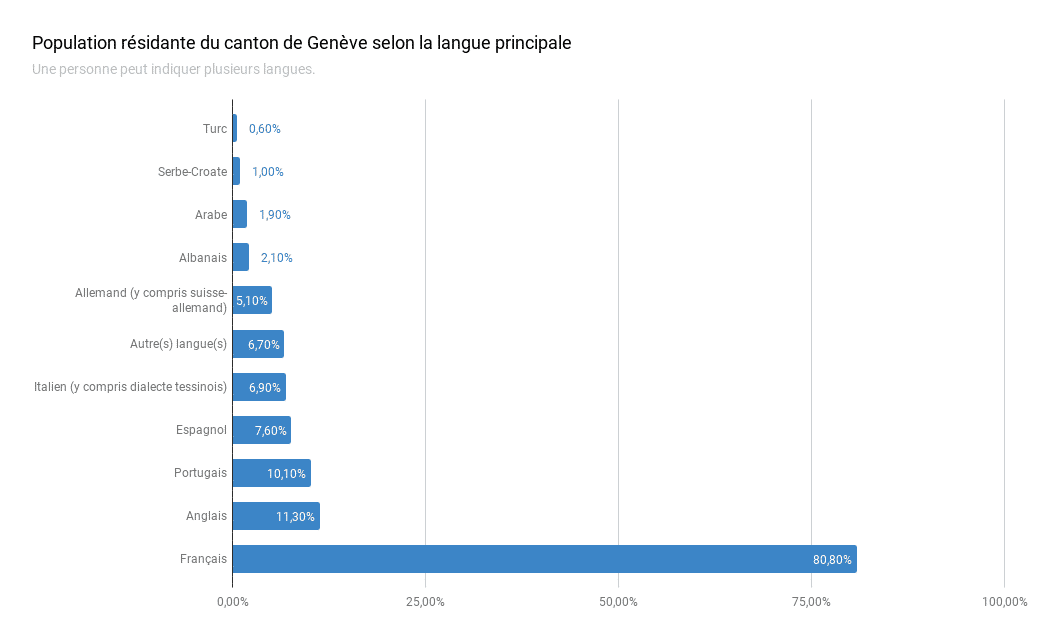
Taking courses to learn or improve your English is essential for facilitating your personal and professional interactions. As English is the language most commonly used in many companies, it is therefore essential.
For language courses, we recommend:
- Migros Club School;
- UOG, Geneva Workers’ University;
- People’s University of the Canton of Geneva;
- Ifage;
- ASC Languages.
Getting to know the people of Geneva
There are many preconceptions about the people of Geneva:
- “It’s not easy to win their trust”
- “They speak slowly and have a strange accent”
- “They’re not very welcoming”
But that said, isn’t it you who have a different accent? Discover the clichés about the Swiss, perfectly captured in the article by Largeur.
Here’s a little insight into the stereotype about Geneva: ‘There used to be a zoo in Geneva. They had to close it because the crocodiles were getting depressed about not having the biggest mouth.’
It is important not to fixate on these reviews: form your own opinion and don’t dwell on the posts (on forums, in articles, etc.) that you might find online. These experiences may be very positive or negative, but they will rarely reflect your own reality. In this case, there is nothing better than experiencing the situation for yourself, without preconceptions, which could distort your perception of the locals and lead to inappropriate behaviour.
Getting around Geneva: diverse and high-quality transport options
You won’t need a car to get around Geneva, as the city’s transport services are excellent. You can easily travel from one part of Geneva to another thanks to the TPG’s extensive network of bus and tram routes.
The rail network allows you to travel throughout Switzerland, as well as to neighbouring countries such as France. When you step back and look at the bigger picture, Geneva is very well situated. Geneva Airport, meanwhile, is located close to the city centre. There are numerous destinations available, so you can travel abroad with ease.
Where can I find accommodation in Geneva?
Moving to Geneva is no easy feat. If you’re looking for a place to live, you need to be prepared for a real treasure hunt, with plenty of applicants and very few successful ones. There are few flats available, and your application will face stiff competition.
Becoming a tenant in Geneva
In Geneva, the number of flats available to rent is far lower than the number of people looking for one. Finding a place to live takes a lot of time, but above all, you need to be very quick off the mark. Flats are snapped up within a matter of days, or even hours.
As a result, viewing times are not necessarily flexible, and viewings are very often organised in groups. The vacancy rate for flats in Geneva was just 0.51%, equating to 1,222 available properties. Geneva ranks among the cities with the lowest vacancy rates: the vacancy rate for Switzerland as a whole stands at 1.54%.
Rental application in Geneva: what documents are required?
If you’re starting to look for a place to live in Geneva, make sure your application is complete. To find a flat in Geneva, you need to be proactive and well prepared. Here is a list of the essential documents you’ll need for your rental application.
Flat hunters
Looking for a flat can be exhausting and discouraging. There is an alternative: hiring a flat-hunting agent. These professionals take the search off your hands, arrange viewings, and submit your application…
These services are provided for a reasonable fee: generally speaking, the cost is equivalent to one month’s rent. So, if your property hunter finds you a flat with a rent of CHF 1,900, their service will cost you the same amount.
It’s simple: you set the criteria (number of rooms, neighbourhoods, rent, etc.) and your property hunter will take care of everything for you!
Rent prices in Geneva
Don’t be caught off guard: living in Switzerland comes at a cost, and even more so in Geneva. If you’re a tenant, bear in mind that rents are constantly rising, mainly due to the imbalance between supply and demand. The average rent for a four-room flat (two bedrooms, a kitchen and a living room) is between CHF 1,900 and CHF 2,100.
To cope with these high prices, it may be worth considering options such as sharing a flat, so that you can split not only the rent but also the service charges. On average, rent accounts for 15.7% of a household’s monthly expenditure in Switzerland.
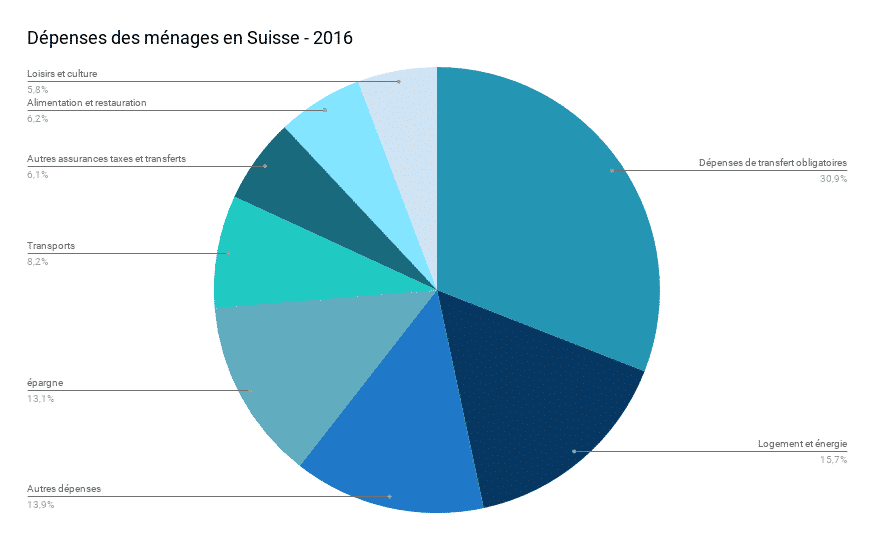
To keep your spending in check, remember to plan ahead and look into ways to save money.
Buying a property in Geneva
If you’re aiming higher and wish to buy a property in Geneva, whether to live there or as an investment, make sure you first familiarise yourself thoroughly with all the specifics of the Swiss property market.
Valuing the property, the buying and negotiation process, the types of loans available to you, the taxes you’ll need to pay… There are many questions to consider, not to mention one that might not be immediately obvious: is it better to borrow in euros or Swiss francs? The impact of currency risk will vary depending on your decision.
Living as a cross-border worker while settling in
It can sometimes be complicated or time-consuming to obtain all the necessary documents, particularly a work permit, in order to rent a property in Geneva. Many people have chosen to become cross-border workers and live in neighbouring France whilst they settle in, await their work permit or find a job. If you come from a European Union country, it is generally easier to find accommodation on the other side of the border.
Good to know: If you’ve managed to find a place to live, b-sharpe allows you to make certain payments, including your first month’s rent. This means you don’t need to rush to find the bank you want: you’ve got time to settle in at your own pace!
Handle administrative tasks without stress
Applying for a work permit, health insurance, taxes… When you move to a new country, there are plenty of administrative procedures to sort out. Here is the essential information you need to complete your applications with peace of mind.
Banking and currencies
When you move to Geneva, you will need to open a Swiss bank account. There are many banks to choose from, all offering high-quality services. As for currency exchange, there are several options available to you: bureaux de change, your bank, or online currency exchange services.
The application for a work permit
When you find a job in Geneva, you are required to apply for a work permit. As an expatriate, you will need either a B permit or an L permit, depending on the length of your employment contract. You can find all the information you need to apply for a permit on the official website of the Canton of Geneva.
Choosing health insurance in Switzerland
Health insurance (LAMal) is compulsory for all residents in Switzerland. Upon your arrival in Geneva, you have three months to take out health insurance. These three months are backdated, so there is no point in waiting to prove your health insurance cover. If you fail to meet this deadline, you will face a penalty. Here is all the information you need regarding choosing an insurer.
Legal protection
Life isn’t always plain sailing! A dispute with your employer, the tax authorities, or a traffic offence… And suddenly you find yourself having to take the matter to court or defend yourself. How can you get help?
Tip 1: Take out legal protection cover. It will support you throughout the process, from providing simple legal advice to organising your defence should legal proceedings arise. A legal protection policy protects you in the event of disputes in your private life (with your landlord, your neighbour, etc.) and at work (with your health insurance provider, your employer, the authorities, etc.).
If you are a cross-border worker and have home insurance, you are covered for private disputes (thanks to the civil liability cover included), but under no circumstances for professional disputes.
Tip 2: Use an independent broker to help you choose the right insurance with peace of mind. Choosing the right insurance can quickly become a headache (areas of law covered, services offered, etc.). Want to find out more? Contact our partner, Swiss Risk & Care, a leading insurance broker.
Tax return
If you hold a B or L licence, your tax is deducted directly at source. Your employer therefore deducts the amount of tax corresponding to your contribution to cantonal and municipal tax, as well as direct federal tax, from your salary each month. Here is all the information you need to understand taxation in Geneva as a resident.
Aim: to break the ice with the people of Geneva!
As an expat, building a network is an important but challenging task. The languages you speak, or knowing where to look for activities, can help you expand your social circle.
Platforms for finding events in Geneva
There are several platforms where you can find activities designed to help you meet new people:
Good to know: There are also plenty of expat groups and events on Facebook.
Get out of the house!
The real secret to settling in Switzerland is getting involved in local life. Great importance is placed on the role of the individual within the community. Find out about events and organisations in your local area and get involved in local life. When you move to a new town or a new country, your comfort zone is challenged.
Diversify your circle of friends
Be careful, however, not to limit yourself solely to expat groups and stick with people who speak the same language as you or come from the same place.
Find out about local events in your neighbourhood or around the city. If you look carefully, you’ll find events such as the food truck festival, the Christmas market in Parc des Bastions, the Fête de l’Escalade with the famous marmite genevoise, or the Course de l’Escalade, for example.
I joined my partner, who has been living in Switzerland for several years now. I won’t lie to you – the first few months were tough! Looking for a job took up a lot of my time. I found myself up against stiff competition and my patience was really put to the test.
Today, thanks to my career and my personal network, I am proud to be living in Switzerland, even though I still have a lot to learn and discover before I really feel at home here.
The culture clash between France and Geneva was something I hadn’t expected: I’d always thought of Geneva as a ‘French’ city.
If I had one piece of advice to give you, it would be this: don’t hesitate to ask for help. The process (especially the administrative side of things) can be daunting, and you’re bound to know someone who’s been through it before and can offer advice or help you make sense of it all.
Do you know the most commonly used expressions and words in French-speaking Switzerland?As you may know, there are four national languages in Switzerland: German, French, Italian and Romansh. In French-speaking Switzerland, French is the language used. In the cantons of Geneva, Jura, Neuchâtel and Vaud, as well as in Fribourg, Valais and Bern, the Swiss speak French. However, French in Switzerland sometimes seems different from the French spoken in France. Old expressions and words are still used in Switzerland. The best-known examples are ‘septante’ and ‘nonante’.
At b-sharpe, the phrases we use most often are:
 |  |
Service | Thank you, it’s only right |
All the best | All the best / Best of luck |
It’s on | It works / It’s fine |
There’s no rush | There’s no rush |
How’s the chalet? | Are you out of your mind? |
| I am delighted | I can’t wait, I’m really looking forward to it |
Here are some other terms and expressions you’re likely to hear in French-speaking Switzerland.
| |
The mobile phone | The mobile phone |
Cover | Cardigan |
A cover | A pouch for storing documents or mobile phone cases |
A cone/a bag | A plastic bag/paper bag |
Health | Used when someone sneezes; equivalent to “bless you” |
Just do it | Please |
The rag | The mop |
A bobet | A fool, a simpleton |
The Föhn | A hairdryer / the name of a hot wind that blows from the south |
Farewell | Hello / Goodbye |
Bizingue | Across, in a zigzag |
Have a smoke | Have a quick nap |
A can | A pint |
Pive | Pine cone |
Yoghurt | Yoghurt |
Action | Special offer |
To park | Parking |
To get a taste | To kiss each other on the cheek |
Putting the church back at the heart of the village | Putting things back in order |
To be on the ball | To hesitate |
Get into the swing of things | Get to safety |
Out of the blue | Expresses surprise using “for God’s sake” |
A bucket | A drink |
The cheni | The mess |
A cloth | A towel |
One share | A promotion, a discount |
A duvet | A duvet |
Curd | Cottage cheese |
Iced tea | Iced tea |
Cash machine | Cash machine |
Voting | Vote |
Kitchen roll | Sopalin |
Receipt | Receipt, ticket |
| It’s pleasantly warm / It’s pleasantly cold | It’s pleasantly warm / cold |
Here are some useful resources to help you learn more about the Swiss dialect:
- https://frontalier.moncoachfinance.com/2017/09/petit-guide-dexpressions-idiomatiques-pour-la-suisse-francophone-6435.html
- https://www.skipass.com/blogs/clash/dictionnaire-franco-suisse.html
- https://www.instagram.com/cajoueoubien_officiel/?hl=fr
The list we’ve provided in this article is, of course, by no means exhaustive. If you can think of any other expressions, please do share them with us in the comments – we’d be happy to add them!
The 4 best places to visit in Switzerland for your holidayLugano and its lake: Italian-style relaxation
Claire and Marie recommend a visit to Lugano, a charming town in the canton of Ticino, on the border with Italy. Whether you’re spending a few days with the family or on a romantic getaway, it’s a dream destination with its lake and the mountains close by. The Italian influence is evident both in the cuisine and in the laid-back atmosphere that pervades the town.
Enjoy the town centre as you wander through the narrow streets; along the way you’ll come across charming little shops and ice-cream parlours serving refreshing soft-serve ice cream, and you’ll hear Italian, German, English and French spoken on every street corner!
From the town centre, you can head down to the lakeside and go for a stroll, taking in the views surrounded by mountains. On sunny days, you can even go for a swim or take a boat trip.
You can reach Mont Brè by funicular – head up to the top and enjoy a panoramic view of the lake and the town! The funicular departs from Cassarate, which is a 20-minute bus ride from the town centre. Once you reach the top, make your way to the village of Brè with its narrow streets and stone houses.
Our recommended ice cream parlour: -9 Gelato Italiano
The restaurant we loved: Ristorante Tango
Lausanne: a treat for the taste buds and the eyes
Abdallah, who has lived in Lausanne for several years, shares his favourite spots and places with you! Lausanne, in the canton of Vaud, is less than an hour’s drive from Geneva. It is a city much loved for its cultural and architectural heritage, as well as for its location between the lake and the mountains.
If you get the chance to spend a few days there, Abdallah recommends you visit Le Milan restaurant, where the aromas of southern Italian cuisine and the friendly staff will transport you to another world.
Staying on the theme of fine dining, do pop into Mon Ami, a delicatessen run by two brothers who are passionate about fine dining and, above all, local produce. You won’t be disappointed by this culinary detour!
Just a twenty-minute drive from Lausanne, head to the stunning terrace at the Baron Tavernier. You can sip a cocktail whilst taking in the breathtaking views of Lake Geneva and soaking up the peace and quiet of the surroundings.
Brienz, a charming lakeside village
If you’re looking to recharge your batteries, Brienz is the destination Brice recommends. Located in the canton of Bern, on the shores of Lake Brienz with its turquoise waters and surrounded by mountains, you’re sure to fall in love with this village.
Its proximity to Interlaken and Thun, along with the many surrounding mountains, makes it the perfect destination for enjoying the great outdoors and getting away from it all. With hiking, paragliding, funicular rides and water sports to choose from, you’re sure to find plenty to keep you busy!
To get a bird’s-eye view and enjoy the panoramic scenery, take the cable car up to Harder Kulm. The scenery is magnificent: you’ll find yourself facing the Eiger, the Mönch and the Jungfrau, and looking down over Lake Brienz and Lake Thun.
Gruyères, a medieval town in the heart of Switzerland
Gruyères is a must-see destination if you want to explore Switzerland. Clément recommends visiting during the Swiss National Day on 1 August, when the town comes alive and you can enjoy a musical performance featuring the alphorn. Throughout the year, events and activities are organised in the medieval village; for example, there’s a Christmas market in the run-up to Christmas.
In Gruyères, you can visit the castle, which is the second most visited castle in Switzerland. Not far from the castle is the HR Giger Museum; fans of the “Alien” films will have the chance to immerse themselves in the fantastical world of the Swiss artist, who was notably recognised for his artistic contribution to the film “Alien”.
If you’re visiting Gruyères, a visit to the Maison du Gruyère is an absolute must! To find out more about the history, expertise and all the secrets behind the production of Switzerland’s most popular cheese, this is a visit not to be missed.
Switzerland is a breathtaking country, home to magnificent landscapes and places. The four towns we’ve featured in this article are just a taste of all the destinations you can explore. Please do share your favourite spots in Switzerland with us! Stay tuned, as we’ll be telling you more about this wonderful country in future articles!
The best places in Geneva for chocolate loversLäderach, b-sharpe’s official chocolatierLäderach, b-sharpe’s official chocolatier
You might not know this, but our offices were right in the heart of Geneva, in the Galerie Jean-Malbuisson. And in that gallery, there’s also a shop run by the Swiss chocolatier Läderach. To be honest with you, all of us at b-sharpe have succumbed to temptation more than once when walking past their window display. It was very rare not to see Läderach chocolate in our open-plan office!
We strongly recommend you try their chocolates if you get the chance. Our top pick: FRISCHSCHOGGI™ Almond Dark – it’s one of our team’s favourites.
Geneva’s finest chocolatiers
Marie, who (admits to) having a great passion for chocolate, has agreed to reveal her favourite chocolatiers in Geneva! Here is the list:
A multi-award-winning confectioner and chocolatier, you’ll find their shops at Les Halles de Rive and La Servette. Every visit is a new discovery: Ducret Confectionery shares their passion through their seasonal collections and limited editions. You can even order bespoke creations for your events, trade fairs or birthdays!
You’ll find this family-run chocolate shop in Balexert. A family business that has been going strong for six generations and continues to uphold the tradition of chocolate-making. Their chocolates, made using traditional methods, are a testament to their delicacy and quality.

Another shop located right next to the b-sharpe offices! Auer is a Geneva institution and the only place that makes the famous “pavés de Genève”. If you’ve never had the chance to try these chocolates, Marie recommends you go and give them a taste. Many locals recommend popping in.

For a truly unique experience, this is the place for you. Philippe Pascoët is a Swiss master chocolatier who creates one-of-a-kind treats. His creations, particularly his flavoured chocolates, are well worth a visit – a treat for both the eyes and the taste buds!
Guided tour at Favarger
If tasting chocolate isn’t enough for you, Favarger, the renowned Geneva-based chocolatier, offers guided tours of their factory. They are based in Versoix, less than a 20-minute drive from the centre of Geneva. The Favarger master chocolatiers will immerse you in their world; from roasting to the finishing touches, you’ll discover all the secrets of the factory.
For more information on bookings and prices, please visit this page:
https://chocolats.favarger.com/fr/decouvrir-la-manufacture/visite-guidee/
The chocolate event not to be missed in Geneva: The Chocolate Rally
Every year since 2015, Geneva has hosted the Rallye du Chocolat, a walking tour of the city designed to introduce visitors to artisan chocolatiers. The aim is to discover the various chocolatiers whilst strolling through the city; a competition is organised along the route, allowing you to vote for your favourite chocolatier.
This year, given the health situation, a slightly different format was introduced: the e-Rallye du Chocolat. You could still explore the town and visit the various chocolate shops, but you also had the option of taking part via your mobile phone or computer from the comfort of your own home.
Whether you’re a real chocolate lover or simply have an irresistible craving for chocolate, Geneva – indeed, the whole of Switzerland – is the perfect place for you. Now that you know the best places to enjoy authentic Swiss chocolate, do share your chocolate-related experiences with us!
Things to do in Geneva! Our selection of must-see attractions!A must-see: the water jet

Everyone will tell you this, and you simply can’t visit Geneva without seeing the Jet d’Eau! This iconic landmark of the city of Geneva, built in 1891, reaches a height of 140 metres and is a tourist attraction not to be missed. Be aware, however, that the Jet d’Eau may sometimes be turned off depending on the weather, for example if it’s too windy.
Our tip: to get to the Jet d’Eau pier, take a stroll through the English Garden. There you’ll find the floral clock, a few souvenir stalls and some bars where you can enjoy a drink whilst taking in the view of the lake.
On Lake Geneva, from Geneva, you can also go on a boat trip, hire a small boat or a pedalo. Make the most of the calm waters and go for a swim in the lake.
Ideas for those on a tight budget
It is possible to spend a few days in Geneva without breaking the bank! Here are the activities we recommend if you’re on a tight budget.
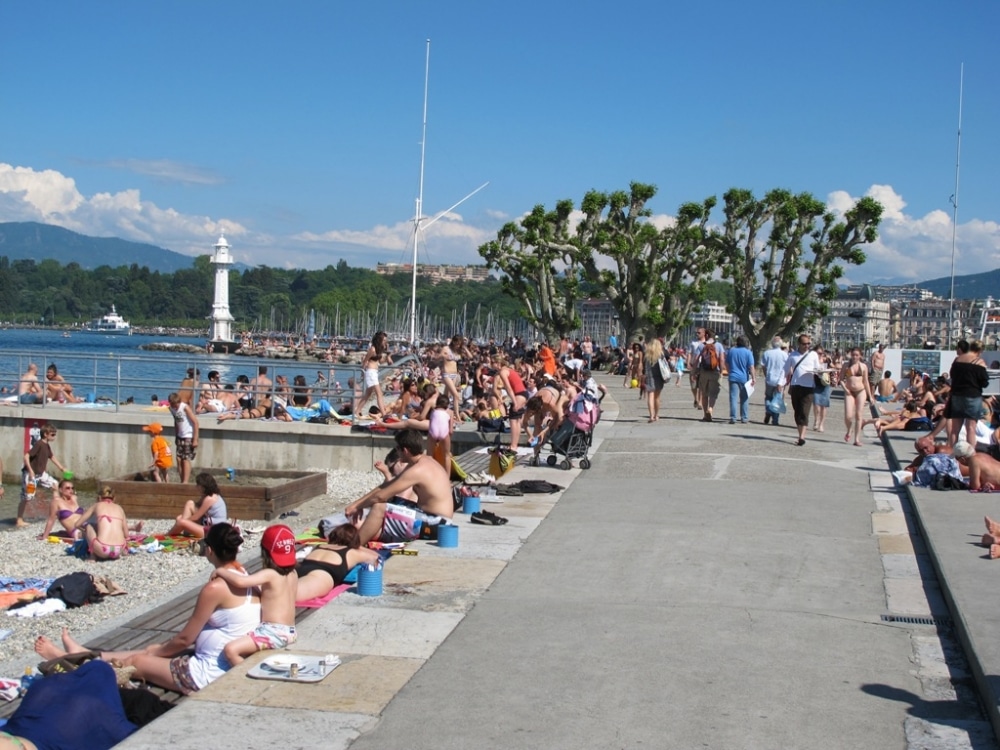
Les Bains des Pâquis
Les Bains des Pâquis, located on the right bank of the lake. Here you can go for a swim, enjoy a drink or even have a fondue, in summer or winter.

The descent of the Rhône
Floating down the Rhône on a rubber ring is the highlight of the summer; all you need is a rubber ring or an inflatable boat, which you can also hire on site. Let the current of the Rhône carry you along and enjoy the natural surroundings and the peace and quiet. The journey starts at La Jonction, and there are several stopping points along the way. Do make sure, however, to check the routes in advance.
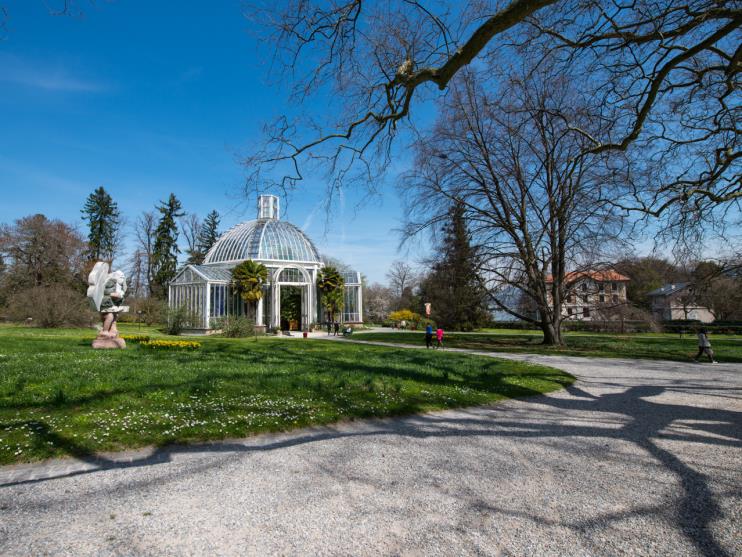
The Geneva Botanical Garden
At the Geneva Conservatory and Botanical Garden, with its magnificent greenhouses and extensive green spaces, you’ll find a peaceful spot for a family stroll.
Challandes Park
Challandes Wildlife Park offers free tours, where you can see lynx, monkeys and a wide variety of birds.
Discover the rich history of watchmaking in Geneva

As Geneva is the capital of luxury watchmaking, why not take the opportunity to immerse yourself in the world of the watch industry? In the city centre, you can admire true gems of Swiss watchmaking in the many shop windows. Take a look at watches from Rolex, Piguet, Omega, Longines, Cartier, Patek Philippe, Tissot and many others.
The Patek Philippe Museum invites you to delve into the history of watchmaking. For an adult admission fee of CHF 10.00, you can explore major collections of watches from Geneva, Switzerland and across Europe.
The Fondation de la Haute Horlogerie occasionally organises introductory workshops on watchmaking. Similarly, Initium offers a range of courses at different prices, allowing you to step into the shoes of an apprentice watchmaker for a short while.
Visit the Franck Muller factory; tours are available on request – simply fill in the contact form on their website. You’ll enjoy a guided tour that gives you a behind-the-scenes look at Swiss watchmaking.
Between history and science
At the foot of Geneva’s Old Town, take a stroll through the Parc des Bastions, where you’ll find the Wall of the Reformers and some giant chess pieces. If you then head up into the Old Town, you can admire St Pierre’s Cathedral and wander through the narrow streets.
There are plenty of museums to visit, including the Natural History Museum, the Museum of Art and History, the Geneva Museum of Ethnography and many others.
Good to know: most of the city’s museums are free on the first Sunday of the month.
Make the most of your stay in Geneva to visit CERN; on the guided tour, discover the technological developments from the first particle accelerator to the LHC, which is now the largest and most powerful particle accelerator in the world.
Geneva is a city that offers a wide range of activities, from cultural and scientific to culinary… We hope that the list we have put together will help you plan your visit and that you will enjoy our recommendations.
Please feel free to share your favourite spots in Geneva in the comments!