















In this exclusive article, b-sharpe, your online currency converter, and our partner GOLD AVENUE answer all your questions and provide you with everything you need to know about investing in gold in 2023.
Why invest in gold?
For thousands of years, gold has retained its value and served as a store of wealth. Even today, it remains a tangible, profitable and sustainable investment. Far from being outdated, investing in gold offers numerous advantages and is a more accessible form of saving than one might think. It is, in fact, attracting more and more young investors. So, why invest in gold? Here are a few pointers to help you better understand this investment.
Is gold a safe haven?
Is investing in gold a safeguard against inflation? Unlike shares, bonds or savings accounts, gold generates no income and its value only increases when it is sold. It is a tangible, physical asset that can be exchanged in person. Yet it is often referred to as a safe-haven asset. Indeed, historically, gold has been a highly sought-after investment during times of crisis, as it is considered safe. In a context of inflation and falling interest rates, gold may prove to be a more sensible and secure financial investment choice. However, despite this positive outlook, bear in mind before investing that all investments carry risks, and that it is impossible to predict with certainty how the price of gold will evolve.
A great way to diversify your savings
This is the golden rule for any investor. As we never tire of repeating, you need to diversify your investment portfolio in order to minimise risk. It is entirely possible to invest your money in precious metals: gold, of course, but also silver, platinum or palladium. Adding one or more gold bars to your investments is therefore a very good idea!
Is investing in gold affordable for everyone?
Investing in gold isn’t necessarily just for the wealthy. The great thing about gold? It can be bought in small amounts! This means you can invest in gold even on a tighter budget. Indeed, the precious yellow metal comes in several forms:
- Ingots, whether cast or struck, weighing between 1 gram and 1 kilogram;
- Gold coins
Good to know: there are two measures of gold purity: carats and fineness. 999.99 pure gold, or 24 carats, is the highest quality available.
When it comes to price, there is gold to suit every budget. Whilst a magnificent 1-kilo gold bar will set you back just under €60,000 (depending on the current gold price), you can just as easily opt for a lighter weight at a lower price. At GOLD AVENUE, you can find gold bars and coins for under €500, and even 1g gold nuggets starting from €70!
How do you invest in gold?
There is a wide range of precious metal dealers you can turn to when investing in gold. You can buy gold from a bank, a high-street dealer or an online dealer. Where should you buy gold? Follow our guide below!
Do banks sell gold bars?
Do banks sell gold bars? In theory, yes, but this is not their core business. These days, very few banks offer this service or hold gold in storage. Check with your bank in advance to find out whether it sells physical gold.
Investing in gold through an online retailer
If you want to invest in gold, you could also choose a retailer with a physical shop. Did you know? It’s entirely possible to invest in gold online. Choose a trusted online dealer such as GOLD AVENUE. By partnering with mines, refineries and reputable companies in the gold industry, GOLD AVENUE offers Swiss gold to suit all budgets, with bars of all weights. An investment you can make with complete transparency!
A few things to bear in mind before investing in gold
Are you thinking of investing in gold? That’s an excellent idea. However, as with any investment, this decision should be carefully considered and approached with caution. So, here are a few things to check before investing in gold:
- Before buying a gold bar, ask your dealer for the names of the producers. This is because only a few refineries are authorised to produce gold bars. They must be accredited by the LBMA (London Bullion Market Association). This is the association of professionals in the London precious metals market. This professional body, based in England, regulates the wholesale markets for gold and silver;
- Check the legal information provided by the retailer (legal notices, Terms and Conditions of Sale), as well as customer reviews and the storage options on offer. In addition, the retailer must provide you with an invoice in your name, showing the date of purchase and details of the products sold;
- Please ensure that payment is made by bank transfer, credit card or bank cheque. The sale of gold for cash is strictly prohibited.
Storage and insurance
The only real drawbacks to investing in gold are storage and security risks. These are important points to consider before investing in gold. Gold is a physical asset that must be stored securely to protect it from theft or damage. Opt for secure storage and insurance. A home safe is an option, but it carries greater risks. Secure storage in a bank is also possible. Finally, please note that GOLD AVENUE offers you the option of storing your purchases made on the site free of charge, up to a value of €10,000. Precious metals are stored in GOLD AVENUE’s secure vaults in Switzerland. An ideal option for highly secure storage of your precious metals, at minimal cost and with complete peace of mind.
Is it a good investment to buy gold in 2023?
Let’s now turn to a crucial question: is it worth investing in gold at the moment?
Gold price trends
Like any commodity, the price of gold is subject to fluctuations. However, its value tends to rise. Indeed, the value of gold tends to increase in times of crisis, inflation or economic uncertainty. It is considered a ‘safe-haven’ asset, less affected by speculation. For example, over the last five years, it has risen by more than 50%. It is therefore a less volatile investment than traditional savings products, which are proving to be less and less profitable.
How do I sell my gold?
Investing in gold means you can sell your holdings at any time and quickly access cash. You can sell your gold to a precious metals dealer. However, it is also possible to sell your gold online to a certified dealer. GOLD AVENUE buys and sells gold stored exclusively in its vaults, directly online and securely. Sell as much gold as you wish and receive your money within 72 hours. GOLD AVENUE buys your precious metals at the SPOT price, i.e. the market price. There are therefore no additional fees or commissions on sales.
Nowadays, many investors are turning to gold to safeguard their savings. Despite a number of common misconceptions, investing in gold is by no means the preserve of the wealthy. It is a secure form of saving that is accessible to everyone. Gold bars and fine gold coins are available for purchase at lower prices, allowing people of all ages to build up savings in gold and create long-term wealth.
For more information:
B-sharpe is a trusted financial partner for online currency exchange. Use our US dollar to Swiss franc converter or our euro to Swiss franc converter for all your international transactions, to or from Switzerland!
GOLD AVENUE, a gold partner. As the official online retailer for the MKS PAMP GROUP, the world leader in the precious metals sector, GOLD AVENUE offers a range of precious metals for sale, with a secure storage option. Invest in gold today.
Watch our Q&A session from 20 September 2023 on saving, featuring Alessandro Soldati from GOLD AVENUE and Jean-Marc Sabet from b-sharpe on YouTube: Watch our Live stream
Pillar 3: should you withdraw or continue contributing to it after leaving Switzerland?What is the Swiss 3rd pillar?
As a reminder, the third pillar forms part of Switzerland’s social security system, as defined by the constitution. It applies to all Swiss workers, regardless of their salary. How does the third pillar work? Let’s take a closer look at this complex system and its specific features.
The three-pillar system
The Swiss social security and pension system is based on three pillars:
- The first pillar covers basic social security, old-age and survivors’ insurance, or AVS.
- The second pillar covers occupational pension provision and retirement insurance, as governed by the Federal Act on Occupational Pension Provision (the famous LPP!). It also applies to cross-border workers.
- The third pillar: this refers to private pension provision. It is optional and voluntary. The third pillar allows you to supplement your second pillar and build up retirement savings. It therefore includes various insurance products, such as savings schemes, life insurance policies and investment funds.
The different types of third-pillar schemes
How can you make sense of this somewhat complex Swiss pension system? Without going into too much detail, there isn’t just one, but several forms of the third pillar:
- The 3rd pillar A (occupational pension scheme) – the bank-based model. It allows working people (employees, self-employed individuals and the unemployed) to make contributions, which are deducted from their income. When filing their tax returns, these contributions generally enable them to reduce their tax liability. Contributions are voluntary and can be stopped at any time, but they are subject to a cap.
- The 3rd pillar A (occupational pension) insurance model. It incorporates the features of the 3rd pillar A, with the additional option of choosing a “death benefit” or “disability benefit”. Unlike the 3rd pillar A banking model, contributions are generally not flexible.
- The 3rd pillar B (insurance model). It allows people living in Switzerland, whether in work or not, to make contributions into a life insurance policy. This can take various forms (dynamic funds, money market funds, etc.). The term of this type of policy depends on the product and the insurance company, with a minimum of 5 years (up to 20 years). In the event of early withdrawal (meaning that you decide to stop paying into the policy), significant penalties are incurred.
The third pillar can therefore be taken out either with a bank or with an insurance company.
Which should you choose, 3rd pillar A or B? It all depends on your circumstances and the level of cover you require, your tax rate and the tax rules in force where you live.
When can you access or withdraw funds from the 3rd pillar?
There are several situations in which an employee in Switzerland can withdraw funds from their tied 3rd pillar (or 3A) pension plan:
- Leaving the country for good (that is the subject of this article!)
- Becoming self-employed
- Buying a property as your main residence
- Changing your 3rd pillar scheme by switching to a different option (3rd pillar B). It is then possible to transfer the funds.
- In the event of disability
For the voluntary third pillar (or 3B), the conditions for withdrawal or cancellation are more flexible. The initial withdrawal date is specified in the insurance policy, on your contract. However, it is also possible to withdraw funds from the third pillar B whenever you wish, without having to give a reason.
What is the contribution limit for the 3rd pillar in 2022?
In 2022, the maximum amount you can save into your 3rd pillar pension scheme is the same as in 2021.
Throughout Switzerland, there are limits on the payments you can make between 1 January and 31 December 2022:
- CHF 6,883 if you are an employee and a member of a pension fund
- up to CHF 34,416 if you are self-employed and do not have a 2nd pillar pension (the limit is capped at 20% of your annual net income)
Please note: These limits apply to 3rd pillar A. The limit for 3rd pillar B depends on your personal circumstances and can be confirmed in more detail by your cantonal tax authority.
I’m leaving Switzerland: what about my third pillar pension?
Is your career in Switzerland coming to an end? If so, you will be entitled to withdraw the full amount of your tied 3rd pillar pension. When you leave Switzerland, you will often wish to continue making contributions to this pension and retirement savings scheme…
Unfortunately, you only have two options:
- Keeping your account in CHF in Switzerland (although many Swiss banks encourage their non-resident customers to close their accounts)
- Paying (a lot of money) for a Swiss bank account just for a few transfers a year
Is it better to reluctantly withdraw your 3rd pillar savings, or to keep contributing to it despite the high fees involved? b-sharpe offers a very simple and cost-effective solution to help you keep contributing to your 3rd pillar!
Should you continue to make contributions to your 3rd pillar pension scheme when you leave Switzerland?
In the case of 3rd pillar A, there is, in principle, no point in continuing to make contributions, as the tax benefit applies only to people who live in Switzerland or work there. In 2021, the tax benefit was even abolished for all cross-border workers who do not have quasi-resident tax status, which applies to the majority of them. In this specific case, withdrawing funds from the third pillar is therefore the best option.
In the case of 3rd pillar B, early withdrawal penalties apply if funds are withdrawn before the end of the contract term. These penalties are particularly steep (amounting to several thousand Swiss francs), and it is therefore preferable, if possible, to continue making contributions from abroad.
However, the issue of currency exchange fees arises, as subscribers living outside Switzerland will need to contribute to their third pillar pension scheme in Swiss francs, even though they are paid in a different currency. Currency exchange transactions will therefore be necessary via a currency converter…
How do you make contributions to a 3rd pillar pension scheme if you no longer live in Switzerland?
Do you now live outside Switzerland but would like to continue contributing to your Swiss pension scheme? Here are the various options for making contributions to a 3rd pillar pension plan.
Let’s take the most common example of someone who has euros at their disposal:
- Send euros (or any other currency) directly to fund the third pillar. The insurance company may provide the third pillar holder with a premium deposit account in CHF (free of charge, but this CHF account, which is specifically intended to receive third pillar premiums, must be requested explicitly). The holder can then make an international transfer from their euro account, which will incur charges. Furthermore, when the euros arrive in the Swiss franc account, they will be converted at a rate that is generally unfavourable (the bank will apply a margin of between 1.65% and 2%, as well as additional foreign exchange fees at some banks).
- Maintaining a CHF account with a Swiss bank. If the Swiss bank allows it, it is possible to keep your CHF account after leaving Switzerland. This allows you to have an account from which to make the necessary payments to top up your 3rd pillar pension. In this case, you will need to make contributions to this account. It is also a potentially very costly solution if the money is sent directly from the euro account abroad, on top of the monthly fees charged by the Swiss bank.
- Using b-sharpe: to avoid these significant charges and make life easier for expats in this situation, b-sharpe offers its clients a multi-currency account and a euro-to-Swiss franc converter. Here’s how it works: the client transfers euros free of charge to the EUR account provided by b-sharpe (this transfer is a SEPA transfer, so there are no fees). Upon receipt of these euros, b-sharpe converts them into Swiss francs and transfers them: either to the CHF premium deposit account under the 3rd pillar, or directly to settle the BVR (payment slip).
Why use an online currency exchange service?
With this final solution, the customers concerned come out on top in every respect, because:
- It is not necessary to hold a bank account in Switzerland
- There are no transfer fees (as this is a SEPA transfer)
- b-sharpe’s low foreign exchange margins allow you to cut your bank charges by two-thirds
- b-sharpe is a service with no subscription fees, no sign-up costs, and is completely secure, with £3 million in insurance cover against hacking or misappropriation of funds
Start using b-sharpe and top up your 3rd pillar pension at minimal cost, whilst making significant savings on your currency exchange transactions! 100% online, b-sharpe is easy to use: it takes just 5 minutes to sign up for our currency exchange service.
Importing a vehicle into Switzerland: procedure, documents and feesDepending on the circumstances, the procedure for importing a vehicle into Switzerland can be more or less complex. Regardless of the type of vehicle being imported and the conditions under which it enters Swiss territory, here are all the formalities you will need to complete.
The import procedure
Customs office
When importing a vehicle into Switzerland, you must contact a customs office responsible for commercial goods. Such offices are located at all border crossings that are open to tourist traffic during opening hours and will issue you with a customs clearance certificate for a fee of 20 Swiss francs.
These offices can issue you with a Certificate of Registration (Form 15.25), which gives you two working days to register your vehicle.
However, it is best to notify customs of your arrival in advance, so that you can obtain the official clearance certificate as soon as you cross the border.
Cantonal department
In addition to paying customs duties, your vehicle must be authorised to drive on Swiss roads (motorways and dual-carriageways) by the cantonal authorities.
The Cantonal Road Traffic Office therefore carries out a roadworthiness test to ensure compliance with the following criteria:
- noise regulations;
- exhaust emission standards;
- vehicle construction specifications;
- vehicle specifications;
- registration of the leased vehicle;
- type approval.
Once the road tax has been paid (the rate differs between light vehicles and heavy goods vehicles) and you have been issued with proof of clearance by the customs office, you will be issued with a vignette costing 40 Swiss francs.
Documents to be provided
Customs clearance
In order to pay import duties, you must provide the following documents:
- sales contract or invoice;
- vehicle registration document or registration certificate;
- valid ID;
- e-dec declaration (import customs);
- proof of origin provided by the seller (where applicable).
Please note that you can use the services of a partner to delegate the handling of these customs formalities, for example:
- a customs agency;
- a logistics company;
- a forwarding agency.
If you opt for this solution, please ensure you make your choice before importation. In this case, the customs duties will be paid by the relevant partner before being invoiced to you.
Moving house
If you are moving to Switzerland as a resident and wish to import your vehicle, there are two possible scenarios:
- You purchased your vehicle less than six months ago. In this case, you have one month to provide the required documents and register your vehicle.
- You purchased your vehicle more than six months ago. In this case, you have a period of one year and are eligible for exemption from customs duties and VAT, provided you do not resell your vehicle within the following year.
In all cases, you will need to provide:
- a vehicle registration document;
- proof of identity;
- an invoice showing the date of purchase and the value of the vehicle;
- a work and residence permit, a residence permit certificate or a settlement permit.
Please note: If you wish to claim the exemption, you will be asked to provide a copy of the customs clearance application for household effects.
If you are not eligible for the exemption, you will be liable for:
- 8% VAT;
- a 4% consumption tax;
- taxes and customs duties.
Temporary import
Any temporary importation for purely tourist purposes is permitted without a customs declaration, provided the goods remain in Switzerland for no longer than one year.
Please note, however, that restrictions apply to:
- workers;
- business travellers;
- international students.
VAT and customs duties
Vehicle type
The amount of customs duty charged varies depending on the type of vehicle being imported:
- trailer: CHF 12 per 100 kg;
- caravan: CHF 19 per 100 kg;
- two-wheeled: CHF 37 per 100 kg;
- passenger car: between 12 and 15 CHF per 100 kg;
- motorhome: between 12 and 15 CHF per 100 kg;
- shipment: between 30 and 45 CHF per 100 kg.
Rates and calculations
Customs duties are calculated on the basis of the weight of the imported vehicle and do not depend on its age; these rates are based on the Tares.
However, special rules apply to vehicles originating from countries that have concluded a free trade agreement with Switzerland. Goods imported from such countries may then be exempt from customs duties or benefit from preferential tariffs.
Please note: Valid proof of origin is then required to confirm the exemption.
Tax rates amount to 4% of the total value of the vehicle (converted into Swiss francs) in accordance with Regulation R-68. This includes the sale price or trade-in value.
If the vehicle was gifted by a third party or if any information is missing, the customs office reserves the right to estimate the value of the vehicle.
Good to know: You can find the forms relating to motor vehicle tax here.
The applicable VAT rate is the standard rate of 7.7%, in accordance with current regulations.
CO2 emissions
The revision of the CO₂ Act demonstrates the importance Switzerland attaches to this issue.
Once emissions exceed a certain threshold, penalties are imposed by:
- the Federal Roads Office (FEDRO) for small-scale importers;
- the Swiss Federal Office of Energy (SFOE) for large-scale importers.
For further information, a tool for calculating the applicable penalties is available.
Example of vehicle import
Three years ago, you bought a Renault Clio with a 90-horsepower engine and a kerb weight of 1,200 kg, which you now wish to import into Switzerland.
- Please contact the relevant customs office to process your application and provide the necessary documents.
- If you are a resident: as your vehicle was purchased more than six months ago, you are exempt from VAT and customs duties.
If you are not a resident, you will be required to pay VAT at a rate of 8% of the vehicle’s purchase price, a 4% consumption tax, and customs duties.
- Customs duties amount to a maximum of CHF 15 per 100 kg for a passenger car. As a non-resident, your Clio will therefore incur a maximum of 12 × 15 = CHF 180 in customs duties.
- You will then need to consider your vehicle’s CO₂ emissions, as well as its registration with the relevant local authority.
The procedures for importing a vehicle into Switzerland therefore depend as much on the vehicle’s specifications as on its country of origin and your status. This process is handled both at the border and at cantonal level.
CMU contributions for cross-border workers: refunds are available!Living in France, working in Switzerland: what about my health insurance?
Being a cross-border worker involves a great deal of administrative hassle: changing your bank account, health insurance, filing your tax return differently… France and Switzerland have signed an agreement allowing cross-border workers to choose their health insurance scheme. They therefore have the option of joining either the Swiss or the French system:
- In Switzerland, employees can register with their local health insurance fund under the Swiss statutory LAMal scheme.
- In France, they can join the Social Security Scheme for Cross-Border Workers (CMU) through the Caisse Primaire d’Assurance Maladie.
Good to know: once you have chosen between LAMal and the CMU, the decision is final. You should therefore compare these two options carefully. You have three months from the date you start work in Switzerland to make your choice. Once this period has passed, if you have not chosen a health insurance scheme, you will automatically be enrolled in the Swiss scheme, LAMal.
So, CMU or LAMal? But what are the pros and cons of these two options?
Health insurance for cross-border workers on the Swiss side: LaMal
The LaMal (which stands for Federal Health Insurance Act) is the compulsory health insurance system in Switzerland. By taking out this insurance, French nationals working in Switzerland can benefit from Swiss health cover. This is a major advantage, as the Swiss healthcare system is renowned for the quality of its care. It also offers its members a great deal of freedom in choosing healthcare providers or doctors. For example, in Switzerland, it is possible to consult a specialist directly without having to see a GP first. The waiting times for reimbursement of medical expenses are also shorter.
However, it is important to note that the premiums for LaMal are high, much higher than French social security contributions. If your income as a cross-border worker is not high, this can be a significant burden. Be sure to compare the costs and financial commitments carefully before making your choice. Furthermore, to benefit from the most comprehensive health cover possible, many cross-border workers decide to take out supplementary cover in France, which incurs additional costs.
Under the Swiss health insurance scheme, you will have to pay a monthly premium, plus an excess and a 10% co-payment. For cross-border workers, this excess is set at CHF 300 (approximately €321 after currency conversion) per calendar year for adults. Children are not subject to the excess under their policy. In practical terms, this means that the first 300 Swiss francs spent on your healthcare covered by the LAMal will be at your own expense.
In France, the CMU for cross-border workers
What is the CMU for cross-border workers – Universal Health Cover for cross-border workers?
The CMU for cross-border workers, not to be confused with the traditional CMU (Universal Health Cover), historically refers to an insurance scheme for cross-border workers. The CMU allows cross-border workers in Switzerland:
- to be affiliated to a French scheme
- to access medical care cover in France and Switzerland under certain conditions.
The CMU (Universal Health Cover) offers cross-border workers healthcare cover identical to that of the French General Health Insurance Scheme (social security). The CMU for cross-border workers scheme applies specifically to cross-border workers who do not choose to join the LaMal scheme in Switzerland.
However, CMU cover remains limited, particularly for expensive treatments: hospitalisation, dental care and optical care. This is why the majority opt for supplementary insurance. With the CMU, cross-border workers can receive treatment in Switzerland, subject to certain conditions.
CMU reimbursements for cross-border workers
To calculate the amount of the insurance premium you will have to pay, the French authorities require cross-border workers to submit a tax return.
However, experience shows that the vast majority of cross-border workers make mistakes in this declaration, and most over-declare, which means that most cross-border workers pay too much for their CMU health insurance premium.
Why is health insurance compulsory for cross-border workers in France?
Have you completed your CMU declaration for cross-border workers correctly?
Depending on the time of year you registered, you must declare your income from the previous year or two years prior. This income can be found on the relevant French tax notice. There are various types of income you must declare, as well as various expenses that can be deducted. The URSSAF website provides a list of everything you must and can include in your declaration, as well as an explanatory guide to declaring income.
In summary, on your tax notice, the main tax details taken into account for the calculation of the CMU are:
- “salaries, pensions and net annuities”
- income received by the tax household
- the deductible CSG
- the reference taxable income
The instructions for completing the tax return form are not always entirely clear, and experience shows that around 80% of cross-border workers who have filed their returns have made mistakes and overpaid. This is according to David Talerman, a specialist in cross-border workers and author of the book “Working and Living in Switzerland”.
In which cases can you reclaim part of the CMU contribution?
What many cross-border workers do not realise is that it is, for example, possible to deduct from their income the amount of the CMU contribution paid in the same year, or even maintenance payments made.
The calculation of the CMU premium is closely linked to your tax return. The more “complex” your tax situation is (married, income from different sources, tax deductions in place, etc.), the greater the likelihood that you will make a mistake in your CMU declaration to the CNTFS.
In reality, there are many and varied factors taken into account when calculating the premium (and these may potentially relate to the tax status of a spouse working in France), which makes the calculation more complex.
In the event of an error in the calculation of the CMU premium, there is a three-year retroactive period
The good news is that you can request a correction to your previous declarations, and you can do so for the last three years.
This request can be made either via your account on the URSSAF platform or directly to the CNTFS.
Given the complexity of the calculation and the criteria involved, it may be worth seeking professional help.
Conclusion: take action and regain your purchasing power
Whether you decide to make your CMU correction yourself or with the help of professionals, you now have all the information you need to reclaim part of your CMU contribution.
What is the National Centre for Swiss Cross-Border Workers?
The CNTFS is the National Centre for Swiss Cross-Border Workers, an organisation for French cross-border workers employed in Switzerland. Directly linked to URSSAF, the CNTFS will calculate your health insurance contribution and manage the collection of funds based on your tax returns.
What is URSSAF – the Union for the Collection of Social Security and Family Allowances?
URSSAF is an official body primarily responsible for collecting social security contributions from employers. It oversees the collection of health insurance premiums from cross-border workers.
What is the CMU frontalier – Universal Health Cover for Cross-Border Workers?
The CMU for cross-border workers, not to be confused with the traditional CMU, historically refers to an insurance scheme for cross-border workers, now known as the CNTFS. The CMU allows cross-border workers in Switzerland:
- to be affiliated to a French scheme
- to access medical care cover in France and Switzerland under certain conditions.
The new 2025 health insurance rates for cross-border workers
LaMaL rates in Switzerland rise every year. But for 2025, a significant increase is expected for the 215,000 cross-border workers who cross the border every day to work in neighbouring Switzerland.
How can this be explained? Healthcare expenditure in Switzerland is rising significantly year on year. For 2024, the country is forecasting a 3.6% increase, reaching 95.3 billion francs, and a 3.2% rise in 2025, for an estimated total of 98.4 billion francs.
To ease the burden on Swiss households and harmonise insurance premium levels across the cantons, a solidarity scheme has been introduced. This means that insurers whose policyholders are in better health – and therefore pose a lower risk – will have to pay higher premiums to compensate.
What impact will this have on cross-border workers? This change will indeed have a direct impact on cross-border workers. Their average age is 38, which is significantly lower than that of Swiss residents (54). Cross-border workers therefore constitute a population with a lower medical risk. They will thus have to contribute to this solidarity scheme to help balance the financing of health insurance in Switzerland.
Taking out supplementary health insurance: the choice of many cross-border workers
If you have opted for the CMU, you should bear in mind that its cover is generally insufficient. Consequently, many cross-border workers between France and Switzerland decide to take out supplementary health insurance (or a supplementary health insurance scheme) to supplement the coverage of their healthcare costs. There are schemes specifically designed for cross-border workers. These schemes can cover part of the costs of hospitalisation, medical consultations, dental or optical care, which are often poorly covered by the basic scheme.
Do you work in Switzerland and live in France? If you live, work and shop across two currencies, then you’ll need a good online currency converter! Exchange your currencies simply and securely with b-sharpe. It’s a reliable and transparent option, favoured by many French cross-border workers.
Find out more
Cross-border workers in Switzerland: how do you complete your tax return in France?- Important notice: the information contained in this article is provided for information purposes only. b-sharpe is an online currency exchange service, and our teams are unable to assist you with completing your tax return. We recommend that you contact a tax advisor for this purpose. Thank you for your understanding.
Update to the 2020 tax return for 2019 income.
For French residents, the tax return period for the previous year is already upon us. Residents in Switzerland with income from French sources, and French residents working in Switzerland who have their main residence in France, will also need to file their tax returns. If you’re wondering how to complete your tax return in France, this article is for you. Check out our practical guide to help employees working in Switzerland (in the cantons of Geneva, Vaud, Valais, Basel, Zurich, etc.) file their tax returns in France.
In which country or countries do you have to pay tax when working in Switzerland?
Firstly, there is a tax treaty between Switzerland and France that governs how cross-border workers are taxed in each country, with a number of specific rules designed to prevent double taxation.
Put simply, it is not possible to be taxed in both Switzerland and France on the same income. However, tax rules and principles vary depending on the canton in which you work.
| Location | Place of tax payment | Comments |
|---|---|---|
| Case 1: Someone who works in the canton of Geneva and commutes home every day | Switzerland | These workers pay their taxes in Switzerland and are subject to Swiss withholding tax (the tax is deducted directly from their monthly salary by the Geneva-based company and paid by the company to the cantonal tax authorities). |
| Case 2: A person working in the cantons of Vaud, Valais, Jura, Neuchâtel, Basel-Stadt, Basel-Landschaft, Bern or Solothurn, and commuting home every day | France | A tax agreement signed between France and these cantons stipulates that people working in Switzerland and living in France are taxed in their country of residence, namely France. |
| Case 3: People working in other cantons (Zurich, St. Gallen, Aargau, etc.) and commuting home every day | Switzerland | – |
| Case 4: A person working in any canton and returning home once a week | Switzerland | People who live in Switzerland during the week (weekly cross-border commuters) are always subject to withholding tax in Switzerland, regardless of the canton. |
Please note, however, that if you have received income from French sources during the year (for example, if you started working during the year, or if one of the spouses works in France), you may be taxed in both countries, but not on the same income.
In practical terms, this means that a taxpayer who works in Switzerland and lives in France can either pay tax solely in Switzerland, solely in France, or in both countries.
In which cases is a certificate of tax residence required?
The tax residence certificate is a document that allows taxpayers in scenario 2 to inform the cantonal tax office that they are paying their taxes in France (and, at the same time, to inform the French tax authorities that they will be receiving income from a Swiss employer). This 2041-AS certificate can be downloaded from the French tax authority’s website and must be submitted to your employer.
What are the deadlines for filing your tax return?
The deadlines for filing your 2020 tax return for 2019 income depend on the county in which you live and are summarised in the table below:
| Departments | Deadline for submitting the declaration |
|---|---|
| from 1 to 19 | 4 June 2020 at midnight |
| aged 20 to 54 | 8 June 2020 at midnight |
| from 55 to 976 | 11 June 2020 at midnight |
| Non-French residents | 4 June 2020 at midnight |
Further information is available on the official tax website.
What documents do you need to prepare to complete your tax return correctly?
The main documents you will need to gather for your tax return are as follows:
- An IBAN (bank account details) if this is your first time logging in
- The withholding tax certificate issued by your employer in Switzerland
- Proof of payment of health insurance premiums (issued by the Swiss health insurance fund for the LAMal or by the CNTFS for the CMU)
- Swiss bank account statements (the document must show the interest received)
- Bank statements for accounts held abroad (in any country) for the purpose of declaring the account numbers on Form 3916 (“Declaration of an account held outside France”)
- The payslip provided by your employer
- Any document supporting a tax reduction, such as the annual tax certificate for home tuition detailing the amounts paid during 2018.
For taxpayers with rental income and who may be using tax-saving schemes (such as the Pinel or Duflot schemes):
- An extract from the amortisation schedule for outstanding loans relating to the property in question
- The service charge statement, usually sent by the property management company
To save time, we recommend that you gather these documents before you start completing your tax return.
The b-sharpe guide to completing your tax return in France
- Where should you file your tax return?
- What tax forms do you need to complete for your tax return?
- How to calculate your Swiss-sourced income for inclusion in your tax return
- Which tax form should I use to declare my Swiss income?
- What EUR/CHF exchange rate should I use in my tax return?
- Which accounts need to be reported?
Where should you file your tax return?
Tax returns must be filed online via the French tax authority’s website. Since 2019, online filing has been mandatory for anyone with internet access at their main residence.
Which tax forms do I need to complete?
The tax return in France is structured as follows:
- Form 2042, which is the standard tax return form, and which sets out all the income of the tax household, regardless of the source.
- a set of annexes, each dedicated to specific types of income (such as rental income), which, once completed by the taxpayer, are automatically included (in principle) in the 2042 tax return.
Once you have logged in to the tax office website and entered “basic” information such as your address and personal details, the service allows you to select the sections you wish to display. Each annex corresponds to a specific type of tax return, and this choice is suggested to you based on the type of income you have. Depending on your selections, the annexes will appear in your account.
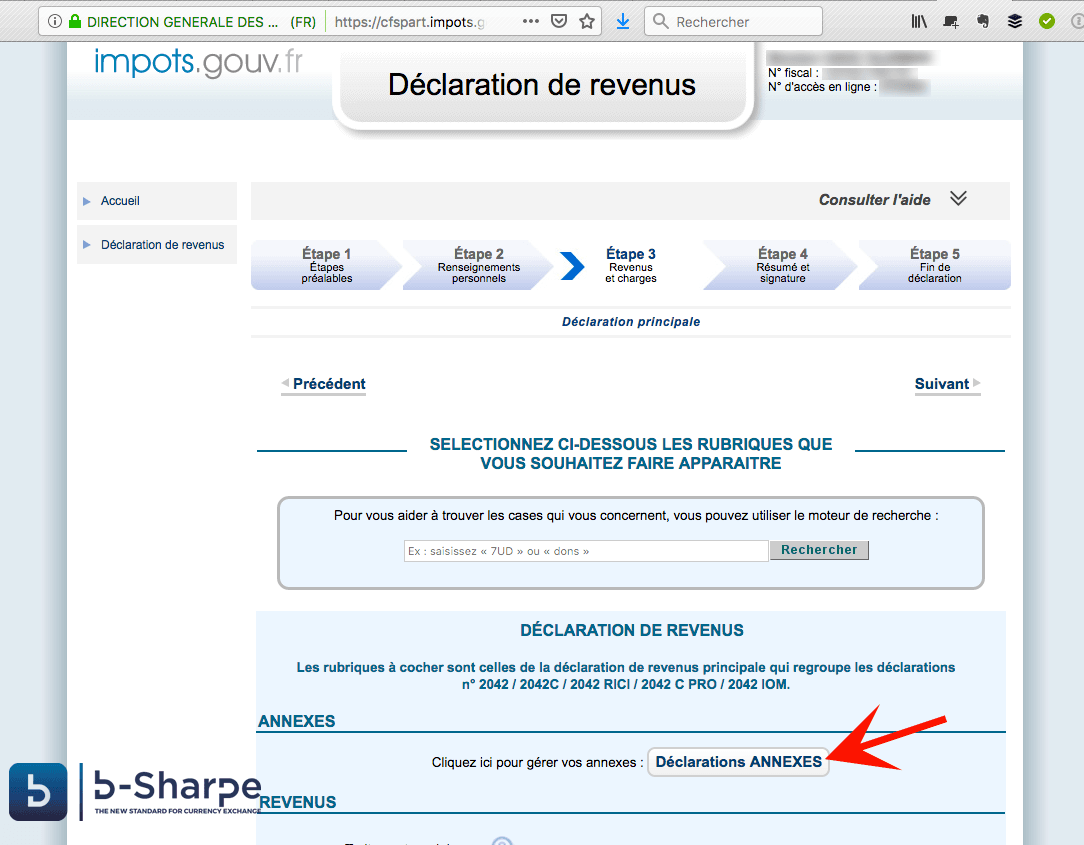
By clicking on the “Supplementary declarations” button, you will see a list of supplementary declarations; you will need to tick the relevant boxes to display them.
In the example given below,
- Selecting the “2019 Property Income Declaration” box (red arrow) will bring up Form 2044, which will allow you to declare any rental income
- The box marked “Declaration of 2019 income received abroad by a taxpayer resident in France” (blue arrow) will bring up Appendix 2047, which allows you to declare Swiss income, as well as the guide to calculating Swiss salary
- Ticking the box marked “Declaration by a resident of an account held outside France” (green arrow) will bring up Appendix 3916, which allows you to enter details of your various foreign accounts.
For a “standard” tax return filed by a taxpayer working in Switzerland, the mandatory annexes are Annexes 2047 and 3916. The others depend on your personal circumstances.
How to calculate your Swiss-sourced income to include in your tax return
The income to be included in the 2020 tax return is that earned in 2019, whether it was earned in Switzerland, France or elsewhere.
Specifically with regard to Swiss income, the following must be included in such income:
- the salary you earn from your employment in Switzerland
- variable pay and any bonuses
- non-wage benefits such as the partial or full payment of health insurance, the private portion of a company car…
Taxable income is the sum of the net amounts received by the employee. This information is set out in the salary statement that your employer should have given you at the start of the year, which is a document summarising all this information.
Unlike employees in France, for whom the French tax authorities pre-fill a tax return that simply needs to be checked and signed off, people working in Switzerland and living in France will have to calculate their own Swiss income to be declared, based on the information provided by their employer.
In this regard, the salary certificate issued by your employer is a key document without which you will not be able to complete your tax return. If your employer(s) have not provided it to you at the start of the year, please ask for it.
Which tax form should I use to declare my Swiss income?
As your income is sourced in Switzerland, the French tax authorities need to carry out some preliminary calculations before including it in your French tax return. To do this, you will need to complete Form 2047, using your Swiss salary certificate as a reference.
#1: State that your income is of Swiss origin
When you log in to the website of the Directorate-General for Taxation, in supplementary form no. 2047, please ensure you tick both boxes as shown in the screenshot below: this will allow you to access the tax return screens specific to people living in France and working in Switzerland.
#2: Calculate your net taxable salary in Switzerland
The next screen will be the guide to calculating your net taxable Swiss salary, which will allow you to “convert” your income in Swiss francs into euros and enter it on your tax return.
To do this, select the member(s) of the tax household working in Switzerland, as well as the number of cantons in which you worked during the year. For example, if a temporary worker living in France has, during the year, worked in the canton of Geneva, the canton of Vaud and the canton of Neuchâtel for three different employers, they must select “3” in the “Number of cantons” box. However, if you have worked for several employers in the same canton, you will need to add up the amounts yourself using the various pay slips you have been given.
#3: Declare your income for each district
On the next page, it is important to select the correct canton of employment and employer (if you have had more than one, please list them in the text box provided). Please also state the number of months for which you received a salary, and enter the information from your Swiss salary certificate(s) in the relevant boxes.
#4: Fill in the boxes using your payslip
The next step is simple: you just need to match the figures on your payslip with those shown in supplementary declaration no. 2047 and fill in the relevant boxes. We have provided an example below; please complete the rest based on your income.
Please note that you will also need your proof of payment for your health insurance premiums (CMU for cross-border workers – CNTFS or LAMal) to complete this form, as shown in the screenshot below. Don’t forget this, as these amounts paid are deducted from your income; it would be a shame not to benefit from this.
As shown in the screenshot below, KVG contributions and CNTFS/URSSAF (CMU) contributions must not be entered in the same field.
#5: Calculating carry-overs
Once you have entered the details from your salary certificate (or certificates, if you have more than one) for each canton, the tax office will carry out what is known as a carry-over: the amount it calculates based on the information you have provided will then be carried over to your other forms, in specific boxes, depending on the circumstances.
It is therefore important to clearly inform the tax authorities of your specific circumstances, as the deferrals may vary from one situation to another (for example, the deferrals for French residents working in the cantons of Vaud, Valais, Jura, Neuchâtel, Basel-Stadt, Basel-Landschaft, Bern and Solothurn will have different carry-forwards to those working in the canton of Geneva).
Once the box has been ticked, the next screen shows you the amount in euros that the French tax authorities have withheld for your tax return. This amount is then normally carried forward to your Annex 2047.
Please note: the service clearly states that the carry-over will be made. However, there are occasions when this is not the case, or when it is not done correctly. We therefore advise you to check carefully that the carry-overs have been entered in the correct boxes.
What EUR/CHF exchange rate should I use for my tax return?
The EUR/CHF exchange rate to be used for your 2020 tax return is 1 CHF = 0.90 EUR. This is provided here for information or verification purposes only, as it is automatically calculated by the tax office’s online service in any case.
Which bank accounts do you need to declare?
French tax law requires taxpayers to declare any foreign bank accounts they hold. Accounts must be declared if there has been at least one debit or credit transaction during the tax year. This declaration is made on Form 3916. It simply involves providing the account numbers and the names of the banks.
For those who have already filed several tax returns, the system allows you to automatically carry forward the information entered the previous year using a carry-forward feature (see screenshot below).
If you’re not sure exactly which account to declare, we invite you to read this post, which deals specifically with the topic of declaring foreign bank accounts.
Conclusion
We hope this guide has helped you with your tax return. If so, please do share this article with your friends, and remember to check out b-sharpe, Switzerland’s leading online currency exchange service offering preferential rates for your currency transactions: registration is free!
Important: this article should under no circumstances be regarded as tax advice.
Credit: all screenshots are taken from the impots.gouv.fr website.
Tax returns in France: accounts that must be declared to the French tax authoritiesThe information that must be provided to the French tax authorities includes accounts held abroad (and therefore outside France, from their perspective). Some of our clients who hold accounts in Switzerland or Germany, or who have third-pillar pension schemes, are affected by this. However, it is not always straightforward to know which accounts must be declared as foreign accounts and which do not. As the consequences for the taxpayer can be significant, potentially leading to fines, we offer a brief practical guide to help you with your tax return in France.
Which taxpayers are required to file a tax return in France?
- Any person residing in Switzerland who receives income from French sources: for example, this applies to someone who rents out a property in France and receives income from it.
- Swiss pensioners who have settled in France and receive income from Switzerland
- French residents who are gainfully employed in Switzerland. Provided they are resident in France, workers in Switzerland are required to file a tax return, even if their income is subject to withholding tax, as is the case, for example, for cross-border workers in Geneva or Zurich.
In short, these taxpayers must file a tax return in France, regardless of the canton in which they work (Geneva, Vaud, Neuchâtel, Zurich, Basel, etc.).
French tax law on the declaration of foreign accounts: what you need to know
Any individual resident in France must declare to the French tax authorities, in their tax return, any accounts they hold abroad. This tax return must include accounts that are currently open or in use, as well as those that have been closed during the year.
The accounts concerned are salary accounts, savings accounts and so-called ordinary accounts held outside France, whether they hold cash or securities, in accordance with the Finance Act.
Furthermore, failure to declare such accounts will result in the taxpayer being liable to a fine of €1,500 per undeclared account.
Bank and savings accounts that must (or do not have to) be declared to the French tax authorities
- Salary accounts, savings accounts (regardless of the currency) and securities accounts held with a Swiss bank (Credit Suisse, UBS, Cantonal Bank, PostFinance, etc.): these accounts must be declared to the French tax authorities.
- Bank accounts in France (including digital banks such as ING Direct, Fortuneo, Boursorama, etc.): these accounts do not need to be declared as foreign accounts.
- Foreign bank accounts: Paragraph 2 of Article 1649 of the General Tax Code (‘CGI’) requires the taxpayers concerned to declare any bank accounts opened, held, used or closed abroad (i.e. outside France); Article 344-A of Annex III to the CGI specifies, for the purposes of applying paragraph 2 of Article 1649 of the CGI, that “an account is deemed to be held […] where [the taxpayer concerned] is the account holder, joint account holder, beneficial owner or economic beneficiary”. The reporting obligation for accounts opened abroad does not require the submission of statements for the accounts in question, but rather the details of those accounts, namely the account name, the name of the institution managing the account (including its address), the account number, the account details, and their opening and closing dates.
- The 3rd pillar: regardless of the type of 3rd pillar you hold (bank or insurance-based 3rd pillar A, or 3rd pillar B), this financial product must be declared to the French tax authorities, as it is considered a foreign account.
- Bank accounts with the German bank N26: some b-sharpe clients, particularly those working in the cantons of Basel and Zurich, hold accounts with N26, the German digital bank. N26 accounts must be declared to the French tax authorities as foreign accounts.
- Any.time-style prepaid accounts: the difficulty here lies in determining in which country the institution managing these services is based. This type of provider is somewhat unique in that they are not, strictly speaking, banks. According to the French tax authorities, however, this type of service undoubtedly serves as a substitute for a bank account and can therefore be considered as such. It is therefore necessary – and this is the difficulty – to know in which country the company managing them is based. Often, they are based in other European countries, which allows them to hold a European licence to provide their services, particularly in France. For example, in the case of Any.time, the company is Belgian. Consequently, this type of account must therefore be declared to the French tax authorities as a foreign account.
- PayPal accounts: many taxpayers have PayPal accounts. Here too, a declaration is required, as PayPal, the company that holds the accounts, is based outside France (in Luxembourg).
However, it is not compulsory to register your PayPal account if:
- The PayPal account is linked to an account held in France
- and the PayPal account received less than 10,000 euros during the year
- and the purpose of a PayPal account is to pay for online purchases (or to receive payments from the sale of goods), not to build up savings.
How to declare your foreign bank accounts
For foreign accounts that must be declared in France on your tax return, the procedure is as follows:
- This declaration is made using CERFA form no. 3916 (or by selecting it directly via the online income tax filing service), and the amounts do not need to be specified
- On the tax return, you must also tick box 8UU (and box 8TT for 3rd pillar B and 3rd pillar A insurance)
- For the third pillar, please state the type of policy on a separate sheet of paper or in the comments section, along with the surrender value as at 31 December of the previous year (this information is usually provided by your insurance company)
What should you do if you’ve forgotten to declare an account?
If you have opened an account abroad, have already filed your tax return for the previous year, and have forgotten to declare this account, simply download the CERFA form no. 3916 above, fill it in and send it to the French tax authorities as a supplementary declaration, or use a separate sheet of paper.
To conclude, I hope this article will help you understand clearly which accounts to declare and which not to, and in any case, I can only urge you to be completely transparent with the tax authorities. I wish you all the best with your tax return!
Please note: the information contained in this article should not be construed as tax advice. If you would like further information, we recommend that you contact the tax authorities, a tax specialist or an accountancy firm.