


Living in Geneva as an expat: everything you need to know before moving there
Are you moving to Geneva and feeling overwhelmed, struggling to find your feet? Whether you’re coming to look for a job or to join your partner, we’ve put together all the essential information you need to prepare for your move with complete peace of mind. From cultural and historical aspects to administrative procedures, discover all our useful tips for expats in Geneva.
• Geneva is a particularly cosmopolitan canton, home to nearly 190 nationalities and 40% foreign residents.
• French remains the most widely spoken language, followed by English, essential in Geneva's professional world.
• Understanding local history and culture eases integration, which typically takes newcomers 4 to 5 years.

Geneva, a multicultural city
Geneva is a cosmopolitan city, known throughout the world, which stands out for its diversity, its idyllic setting, but above all for the quality of life it offers – a quality of life that many people dream of. But do you really know all its facets?
Geneva’s culture: a rich history
When you arrive in a new country or a new city, it is essential to learn about the local culture in order to settle in successfully. And to do that, there is nothing better than looking at the history of Switzerland, and more specifically the history of Geneva.
It usually takes four to five years to really get to grips with Swiss culture, which, incidentally, is quite distinct and quite different from the Latin culture of some neighbouring countries. Understanding the history of the country and its people will help you settle into this new environment more quickly.
Switzerland’s most cosmopolitan canton
Located in the heart of Europe, Geneva is a multicultural city. The canton’s population comprises around 190 different nationalities. In 2018, 40% of the inhabitants of the canton of Geneva were foreign nationals. The four largest foreign communities come from the following countries: Portugal, France, Italy and Spain.
If you’re feeling homesick, you’ll find a range of events and activities organised by expats who meet up regularly. Thanks to this mix of cultures and nationalities, the canton of Geneva stands out from most other cantons.
Languages spoken in Geneva
If you want to settle in, communication is a key aspect that should not be overlooked. Whether you’re out shopping or trying to make friends, you need to be able to express yourself and listen. In Geneva, the most widely spoken language is French, followed by English, not to mention Portuguese, Spanish and Italian.
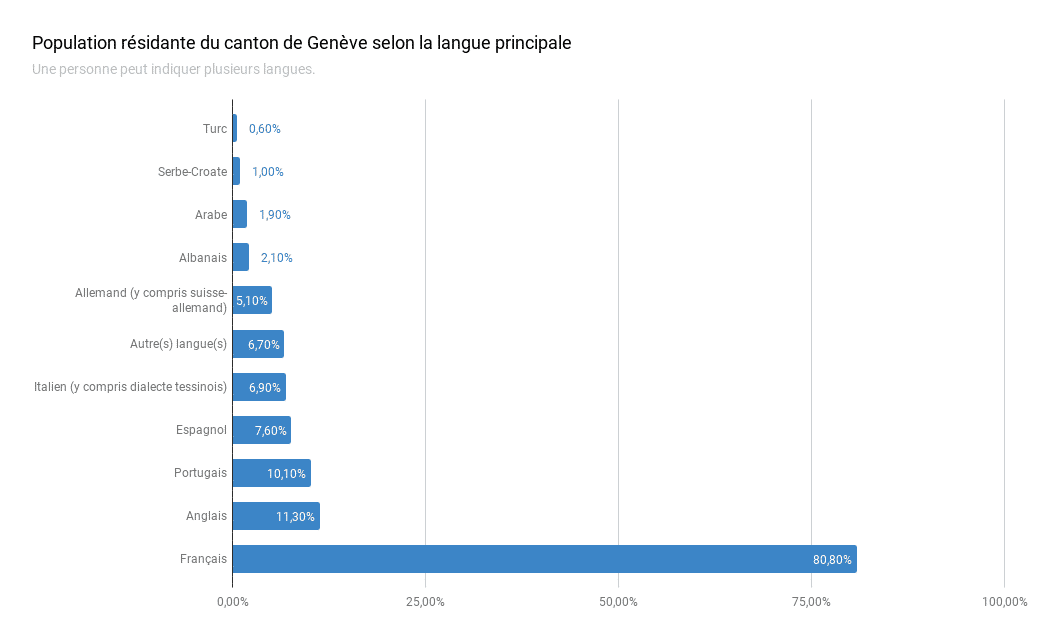
Taking courses to learn or improve your English is essential for facilitating your personal and professional interactions. As English is the language most commonly used in many companies, it is therefore essential.
For language courses, we recommend:
- Migros Club School;
- UOG, Geneva Workers’ University;
- People’s University of the Canton of Geneva;
- Ifage;
- ASC Languages.
Getting to know the people of Geneva
There are many preconceptions about the people of Geneva:
- “It’s not easy to win their trust”
- “They speak slowly and have a strange accent”
- “They’re not very welcoming”
But that said, isn’t it you who have a different accent? Discover the clichés about the Swiss, perfectly captured in the article by Largeur.
Here’s a little insight into the stereotype about Geneva: ‘There used to be a zoo in Geneva. They had to close it because the crocodiles were getting depressed about not having the biggest mouth.’
It is important not to fixate on these reviews: form your own opinion and don’t dwell on the posts (on forums, in articles, etc.) that you might find online. These experiences may be very positive or negative, but they will rarely reflect your own reality. In this case, there is nothing better than experiencing the situation for yourself, without preconceptions, which could distort your perception of the locals and lead to inappropriate behaviour.
Getting around Geneva: diverse and high-quality transport options
You won’t need a car to get around Geneva, as the city’s transport services are excellent. You can easily travel from one part of Geneva to another thanks to the TPG’s extensive network of bus and tram routes.
The rail network allows you to travel throughout Switzerland, as well as to neighbouring countries such as France. When you step back and look at the bigger picture, Geneva is very well situated. Geneva Airport, meanwhile, is located close to the city centre. There are numerous destinations available, so you can travel abroad with ease.
Where can I find accommodation in Geneva?
Moving to Geneva is no easy feat. If you’re looking for a place to live, you need to be prepared for a real treasure hunt, with plenty of applicants and very few successful ones. There are few flats available, and your application will face stiff competition.
Becoming a tenant in Geneva
In Geneva, the number of flats available to rent is far lower than the number of people looking for one. Finding a place to live takes a lot of time, but above all, you need to be very quick off the mark. Flats are snapped up within a matter of days, or even hours.
As a result, viewing times are not necessarily flexible, and viewings are very often organised in groups. The vacancy rate for flats in Geneva was just 0.51%, equating to 1,222 available properties. Geneva ranks among the cities with the lowest vacancy rates: the vacancy rate for Switzerland as a whole stands at 1.54%.
Rental application in Geneva: what documents are required?
If you’re starting to look for a place to live in Geneva, make sure your application is complete. To find a flat in Geneva, you need to be proactive and well prepared. Here is a list of the essential documents you’ll need for your rental application.
Flat hunters
Looking for a flat can be exhausting and discouraging. There is an alternative: hiring a flat-hunting agent. These professionals take the search off your hands, arrange viewings, and submit your application…
These services are provided for a reasonable fee: generally speaking, the cost is equivalent to one month’s rent. So, if your property hunter finds you a flat with a rent of CHF 1,900, their service will cost you the same amount.
It’s simple: you set the criteria (number of rooms, neighbourhoods, rent, etc.) and your property hunter will take care of everything for you!
Rent prices in Geneva
Don’t be caught off guard: living in Switzerland comes at a cost, and even more so in Geneva. If you’re a tenant, bear in mind that rents are constantly rising, mainly due to the imbalance between supply and demand. The average rent for a four-room flat (two bedrooms, a kitchen and a living room) is between CHF 1,900 and CHF 2,100.
To cope with these high prices, it may be worth considering options such as sharing a flat, so that you can split not only the rent but also the service charges. On average, rent accounts for 15.7% of a household’s monthly expenditure in Switzerland.
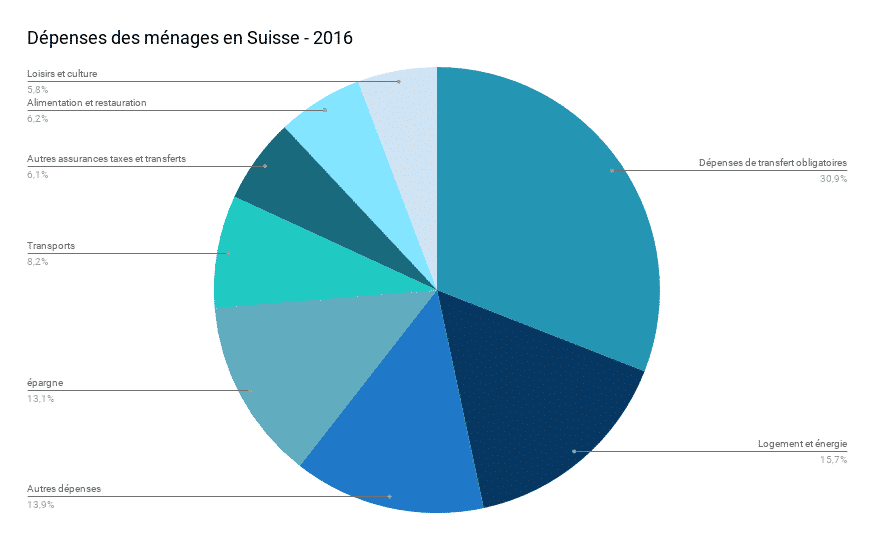
To keep your spending in check, remember to plan ahead and look into ways to save money.
Buying a property in Geneva
If you’re aiming higher and wish to buy a property in Geneva, whether to live there or as an investment, make sure you first familiarise yourself thoroughly with all the specifics of the Swiss property market.
Valuing the property, the buying and negotiation process, the types of loans available to you, the taxes you’ll need to pay… There are many questions to consider, not to mention one that might not be immediately obvious: is it better to borrow in euros or Swiss francs? The impact of currency risk will vary depending on your decision.
Living as a cross-border worker while settling in
It can sometimes be complicated or time-consuming to obtain all the necessary documents, particularly a work permit, in order to rent a property in Geneva. Many people have chosen to become cross-border workers and live in neighbouring France whilst they settle in, await their work permit or find a job. If you come from a European Union country, it is generally easier to find accommodation on the other side of the border.
Good to know: If you’ve managed to find a place to live, b-sharpe allows you to make certain payments, including your first month’s rent. This means you don’t need to rush to find the bank you want: you’ve got time to settle in at your own pace!
Handle administrative tasks without stress
Applying for a work permit, health insurance, taxes… When you move to a new country, there are plenty of administrative procedures to sort out. Here is the essential information you need to complete your applications with peace of mind.
Banking and currencies
When you move to Geneva, you will need to open a Swiss bank account. There are many banks to choose from, all offering high-quality services. As for currency exchange, there are several options available to you: bureaux de change, your bank, or online currency exchange services.
The application for a work permit
When you find a job in Geneva, you are required to apply for a work permit. As an expatriate, you will need either a B permit or an L permit, depending on the length of your employment contract. You can find all the information you need to apply for a permit on the official website of the Canton of Geneva.
Choosing health insurance in Switzerland
Health insurance (LAMal) is compulsory for all residents in Switzerland. Upon your arrival in Geneva, you have three months to take out health insurance. These three months are backdated, so there is no point in waiting to prove your health insurance cover. If you fail to meet this deadline, you will face a penalty. Here is all the information you need regarding choosing an insurer.
Legal protection
Life isn’t always plain sailing! A dispute with your employer, the tax authorities, or a traffic offence… And suddenly you find yourself having to take the matter to court or defend yourself. How can you get help?
Tip 1: Take out legal protection cover. It will support you throughout the process, from providing simple legal advice to organising your defence should legal proceedings arise. A legal protection policy protects you in the event of disputes in your private life (with your landlord, your neighbour, etc.) and at work (with your health insurance provider, your employer, the authorities, etc.).
If you are a cross-border worker and have home insurance, you are covered for private disputes (thanks to the civil liability cover included), but under no circumstances for professional disputes.
Tip 2: Use an independent broker to help you choose the right insurance with peace of mind. Choosing the right insurance can quickly become a headache (areas of law covered, services offered, etc.). Want to find out more? Contact our partner, Swiss Risk & Care, a leading insurance broker.
Tax return
If you hold a B or L licence, your tax is deducted directly at source. Your employer therefore deducts the amount of tax corresponding to your contribution to cantonal and municipal tax, as well as direct federal tax, from your salary each month. Here is all the information you need to understand taxation in Geneva as a resident.
Aim: to break the ice with the people of Geneva!
As an expat, building a network is an important but challenging task. The languages you speak, or knowing where to look for activities, can help you expand your social circle.
Platforms for finding events in Geneva
There are several platforms where you can find activities designed to help you meet new people:
Good to know: There are also plenty of expat groups and events on Facebook.
Get out of the house!
The real secret to settling in Switzerland is getting involved in local life. Great importance is placed on the role of the individual within the community. Find out about events and organisations in your local area and get involved in local life. When you move to a new town or a new country, your comfort zone is challenged.
Diversify your circle of friends
Be careful, however, not to limit yourself solely to expat groups and stick with people who speak the same language as you or come from the same place.
Find out about local events in your neighbourhood or around the city. If you look carefully, you’ll find events such as the food truck festival, the Christmas market in Parc des Bastions, the Fête de l’Escalade with the famous marmite genevoise, or the Course de l’Escalade, for example.

I joined my partner, who has been living in Switzerland for several years now. I won’t lie to you – the first few months were tough! Looking for a job took up a lot of my time. I found myself up against stiff competition and my patience was really put to the test.
Today, thanks to my career and my personal network, I am proud to be living in Switzerland, even though I still have a lot to learn and discover before I really feel at home here.
The culture clash between France and Geneva was something I hadn’t expected: I’d always thought of Geneva as a ‘French’ city.
If I had one piece of advice to give you, it would be this: don’t hesitate to ask for help. The process (especially the administrative side of things) can be daunting, and you’re bound to know someone who’s been through it before and can offer advice or help you make sense of it all.


